


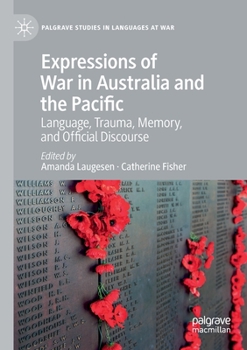
Expressions of War in Australia and the Pacific: Language, Trauma, Memory, and Official Discourse
No Customer Reviews

Select Format
Select Condition 
Book Overview
Chapter 1: Introduction: Expression of war in Australia and the Pacific: Language, trauma, memory, and official discourse (Amanda Laugesen and Catherine Fisher).Chapter 2: Losing people: A linguistic analysis of minimisation in First World War soldiers' accounts of violence (Cara Penry Williams and John Rice-Whetton).Chapter 3: Portraying the enemy: Humour in French and Australian trench journals (V?ronique Duch?).Chapter 4: Mnemosyne and Athena: Mary Booth, Anzac, and the language of remembrance in the First World War and after (Bridget Brooklyn).Chapter 5: Jacques Ranci?re and the politics of war literature: Poetry and trauma in Edmund Blunden's Undertones of War (1928) (Neil Ramsey).Chapter 6: Voicing the war effort: Australian women's broadcasts during the Second World War (Catherine Fisher).Chapter 7: Re-visioning Australia's Second World War: Race hatred, strategic marginalisation, and the visual language of the South West Pacific Campaign (Kevin Foster).Chapter 8: 'No written word can express the sympathy of a spoken word': Casualty telegrams after the Battle for Bardia, 1941 (John Moremon).Chapter 9: The PTS communication framework: analysing the discourse within the Australian Army News (Lisa Ranson and Leanne Glenny).Chapter 10: 'Testament of youth': Young Australians' responses to Anzac (Rebecca Wheatley).Chapter 11: Conclusion: Languages of War (Amanda Laugesen and Catherine Fisher).
Format:Paperback
Language:English
ISBN:303023892X
ISBN13:9783030238926
Release Date:October 2020
Publisher:Palgrave MacMillan
Length:237 Pages
Weight:0.68 lbs.
Dimensions:0.5" x 5.8" x 8.3"
Customer Reviews
0 rating
Copyright © 2026 Thriftbooks.com
Terms of Use | Privacy Policy | Do Not Sell/Share My Personal Information | Cookie Policy | Cookie Preferences | Accessibility Statement
ThriftBooks ® and the ThriftBooks ® logo are registered trademarks of Thrift Books Global, LLC
ThriftBooks ® and the ThriftBooks ® logo are registered trademarks of Thrift Books Global, LLC
