


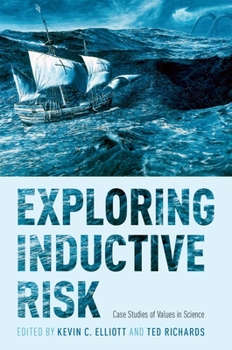
Exploring Inductive Risk: Case Studies of Values in Science
No Customer Reviews

Science is the most reliable means available for understanding the world around us and our place in it. But, since science draws conclusions based on limited empirical evidence, there is always a chance that a scientific inference will be incorrect. That chance, known as inductive risk, is endemic to science. Though inductive risk has always been present in scientific practice, the role of values in responding to it has only recently gained extensive attention from philosophers, scientists, and policy-makers. Exploring Inductive Risk brings together a set of eleven concrete case studies with the goals of illustrating the pervasiveness of inductive risk, assisting scientists and policymakers in responding to it, and moving theoretical discussions of this phenomenon forward. The case studies range over a wide variety of scientific contexts, including the drug approval process, high energy particle physics, dual-use research, climate science, research on gender disparities in employment, clinical trials, and toxicology. The book includes an introductory chapter that provides a conceptual introduction to the topic and a historical overview of the argument that values have an important role to play in responding to inductive risk, as well as a concluding chapter that synthesizes important themes from the book and maps out issues in need of further consideration.
Format:Paperback
Language:English
ISBN:019046772X
ISBN13:9780190467722
Release Date:July 2017
Publisher:Oxford University Press
Length:310 Pages
Weight:0.97 lbs.
Dimensions:0.8" x 6.1" x 9.1"
Customer Reviews
0 rating
Copyright © 2026 Thriftbooks.com Terms of Use
| Privacy Policy | Do Not
Sell/Share My Personal Information | Cookie Policy | Cookie Preferences | Accessibility Statement
ThriftBooks® and the ThriftBooks® logo are registered trademarks of Thrift Books Global, LLC
ThriftBooks® and the ThriftBooks® logo are registered trademarks of Thrift Books Global, LLC
