


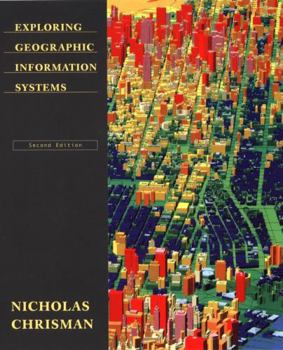
Exploring Geographic Information Systems

Eine Einfuhrung in geographische Informationssysteme (GIS), die uber den ublichen Rahmen vergleichbarer Bucher weit hinausgeht: Hier wird mehr beschrieben als Input, Verarbeitung und Output! Zu den behandelten Themengebieten gehoren Strategien der Vermessung, Darstellungsformen, Datenqualitat, -umwandlung und -operationen, parametrische Abbildungen, logische Prozeduren, Taxonomie, Entfernungstransformationen und Oberflachen. Praktische Anwendungsbeispiele verknupfen den Stoff mit Einsatzgebieten im behordlichen, sozialen und kulturellen Umfeld. Mit zahlreichen Fallstudien!
Format:Paperback
Language:English
ISBN:0471314250
ISBN13:9780471314257
Release Date:May 2001
Publisher:Wiley
Length:320 Pages
Weight:0.75 lbs.
Dimensions:0.5" x 7.6" x 9.2"
Customer Reviews
4 ratings
A refreshing perspective
Published by Thriftbooks.com User , 21 years ago
This book is the main text for an undergraduate course in GIS in my university department. The book serves as a nice introduction to some fundamentals of GISs and does a particularly good job at linking the theoretical constructs and concepts with specific application domains. There are many examples of the applicability of the theories on specific industrial and governmental projects. Chrisman is a gifted author and provides a refreshing perspective of how to think about geographic information systems. It all starts rather abstractly with levels of measurement, reference systems and measurement frameworks. Choices in these levels turn out to be what dictates the adoption of field vs. object data models (the classic dichotomy in GISs) and raster vs. vector structures consequently. The author then proceeds in exposing operations of increasing complexity on these structures, and does a very systematic work on categorizing them. A plethora of diagrams, figures, and footnote-definitions of important terms complement the text nicely. The final chapters on the ties of GISs with society and culture are also very interesting. The whole book has a flow and a strong structure, a feature that I value especially in technical books. There are no loose chapters and everything builds on what has been discussed before. Of course as an introductory textbook it leaves out some areas of investigation and comments only scarcely on others. For example the chapters on comprehensive operations and transformations are just very generic overviews. Models such as spaghetti or topological database structures are also very superficially presented, hence the 4-star rating. Overall, a very interesting, clearly written, and consice introduction to GISs.
An excellent second book for learning GIS
Published by Thriftbooks.com User , 22 years ago
OK, so you've figured out how to drive the software and you've learnt the basic operations. Now, what does it all mean? This book is a great attempt to answer that question.Nick Chrisman has drawn on his wealth of GIS experience to go beyond the basics. Don't expect to learn them here, you'll have to do that elsewhere. But when it gets down to just what it means, this is the place to be.If you want GIS to work in a decision-making environment (which is 100% of its real applications, after all), learn from this book. We have used it as the second GIS text at The Ohio State University's Geodetic Science graduate program, and the students have appreciated its approach and content.BTW, get the second edition (2002), noted here as 'Wie Exploring GIS' for some reason.
Outstanding high-level overview
Published by Thriftbooks.com User , 25 years ago
I am an experienced GIS professional and this book is one of my favorites in my library. It is the best single source for understanding the scientific and technological context of GIS. This book has changed the way I think about GIS.The comment from the reader from Hong Kong is completely off-target. Did this person really read this book?
Excellent overview of Geographic Information Systems
Published by Thriftbooks.com User , 28 years ago
Nick Chrisman, a legend in the field of geographic information systems, provides a refreshing perspective on GIS. I recommend this book to anyone involved in the field, particularly to those planning on teaching GIS. He places GIS in a societal context that is becoming increasing important as this technology becomes mainstream
Copyright © 2025 Thriftbooks.com
Terms of Use | Privacy Policy | Do Not Sell/Share My Personal Information | Cookie Policy | Cookie Preferences | Accessibility Statement
ThriftBooks ® and the ThriftBooks ® logo are registered trademarks of Thrift Books Global, LLC
ThriftBooks ® and the ThriftBooks ® logo are registered trademarks of Thrift Books Global, LLC
