


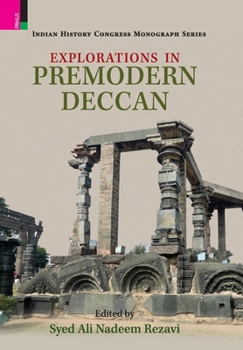
Explorations in Premodern Deccan

The Deccan has long served as a nodal zone of cultural exchange, political negotiation, and technological circulation. Anchoring the subcontinent's interior while connecting it to wider worlds, the plateau has occupied a pivotal place in South Asian history. From the formation of early agrarian landscapes and regional polities, through the intellectually and artistically vibrant courts of the medieval period, to the reconfiguration of authority, economy, and identity under colonial modernity, its past resists linear or reductive narration. The Deccan's history was shaped not only by dynastic power and textual record but also by the movements of artisans, religious specialists, merchants, military contingents, and pastoral and settled communities whose interactions animated its social fabric. Its architectural, metallurgical, and irrigation traditions, along with its literary, musical, and devotional cultures, reveal enduring patterns of encounter, translation, and innovation.
Explorations in the Premodern Deccan arises from a special panel on the Deccan organized by the Indian History Congress at its Warangal (Telangana) session in 2023. Bringing together new and previously published papers, it offers diverse methodological engagements that view the Deccan not as a marginal frontier but as a generative centre in the making of South Asian history.
Customer Reviews
ThriftBooks ® and the ThriftBooks ® logo are registered trademarks of Thrift Books Global, LLC
