


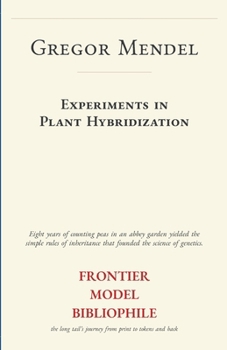
Experiments in Plant Hybridization
No Customer Reviews

From eight years' work with the garden pea, Gregor Mendel extracted a few simple rules - dominant and recessive characters, the 3:1 ratio, the segregation and independent assortment of discrete hereditary factors - and so founded the science of genetics. Ignored in his lifetime and rediscovered in 1900, his short 1866 paper is reproduced here in the Royal Horticultural Society English translation, with a modern reader's apparatus. Mendel's paper appeared in 1866 in the Proceedings of the Natural History Society of Br nn, a respectable but provincial publication, and it sank almost without trace. To understand both the achievement and the neglect, one must see the paper against the science of heredity in the mid-nineteenth century, which scarcely existed as a quantitative discipline. Breeders knew that like tended to beget like and that crosses could blend or break up traits, but the prevailing assumptions - inheritance as a blending of parental fluids, characters as smoothly mixing essences - offered no way to predict outcomes or to count them. Charles Darwin's On the Origin of Species had appeared in 1859, and the question of how variation is transmitted and preserved was central to evolutionary theory; yet Darwin himself had no satisfactory mechanism of inheritance, and his later hypothesis of pangenesis was a blending theory that could not account for the persistence of discrete traits. Into this confusion Mendel introduced a method of startling simplicity. He chose the garden pea, Pisum sativum, for reasons he set out carefully: it is normally self-fertilizing, so its lines could be kept pure; it could be cross-fertilized by hand when required; and it offered sharply contrasting, easily classified characters. He worked with seven such characters, each appearing in two clean alternatives - round versus wrinkled seeds, yellow versus green cotyledons, tall versus short stems, and so on. Crucially, Mendel did not merely observe; he counted, recording the numbers of each type in each generation across tens of thousands of plants. The results were orderly. When Mendel crossed a pure tall plant with a pure short one, the entire first hybrid generation was tall: one character had disappeared. He named the character that appeared in the hybrids dominant and the one that vanished recessive. When he allowed these hybrids to self-fertilize, the recessive character reappeared in the second generation in a consistent proportion: roughly three plants showing the dominant character to one showing the recessive - the famous 3:1 ratio. Probing further, Mendel found that the dominant group was not uniform: of the three, one bred true for the dominant character and two behaved like the hybrids, giving an underlying ratio of 1:2:1. From this he drew the conclusion that has since become the law of segregation: each plant carries two factors for a character, one inherited from each parent; the factors do not blend but remain distinct; and in forming reproductive cells the pair separates, so that each cell carries only one. The reappearance of the recessive trait, and the steady ratios, followed necessarily from factors that segregate cleanly rather than mixing. Mendel went further still. By following two characters at once - seed shape and seed color together - he showed that the pairs are inherited independently of one another, the alternatives recombining in all possible combinations in proportions he again predicted and counted. This is the principle later called independent assortment. Behind both laws lay a quietly radical idea: that heredity is particulate, carried by discrete units that are shuffled and recombined but not diluted.
Format:Paperback
Language:English
ISBN:B0HF464CR9
ISBN13:9798259504066
Release Date:January 2027
Publisher:Frontier Model Bibliophile
Length:72 Pages
Weight:0.21 lbs.
Dimensions:0.1" x 5.5" x 8.5"
Customer Reviews
0 rating
Copyright © 2026 Thriftbooks.com
Terms of Use | Privacy Policy | Do Not Sell/Share My Personal Information | Cookie Notice | Cookie Preferences | Accessibility Statement
ThriftBooks ® and the ThriftBooks ® logo are registered trademarks of Thrift Books Global, LLC
ThriftBooks ® and the ThriftBooks ® logo are registered trademarks of Thrift Books Global, LLC
