


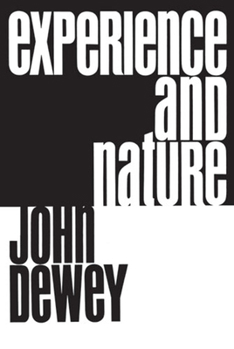
Experience and Nature

Select Format
Select Condition 
Book Overview
This is an enlarged, revised edition of the Paul Carus lecturers which John Dewey delivered in 1925. It covers Dewey's basic formulation of the problem of knowledge, with both a full discussion of theories and resolutions propounded by other systems, and a detailing of Dewey's own concepts upon the relationship of the external world, the minds, and knowledge. Starting with a thorough examination of philosophical method, Dewey examines the interrelationship of experience and nature, and upon the basis of empirical naturalism analyzes experience, the formulation of law, the role of language and social factors in knowledge, the nature of mind, and the final interrelation of mind and matter. Dewey, as in his other mature philosophy, attempts to replace the traditional separation of nature and experience with the idea of continuity, using the traditional separation of nature and experience with the idea of continuity, using the concept of language as the bridge. Dewey's treatment of central problems in philosophy and philosophy of science is profound, yet extremely easy to follow. His range of subject matter is very wide, from the anthropology of Malinowski to gravity, evolution, and the role of art, and his insights are clear and valuable. Scientists, philosophers of science, philosophers, and students of American history of thought will all find this one of the most profitable works by a great 20th-century thinker.
Format:Paperback
Language:English
ISBN:B000K5OO02
ISBN13:9780486204710
Release Date:January 2000
Publisher:Dover Publications
Length:480 Pages
Weight:1.05 lbs.
Dimensions:0.9" x 5.3" x 8.0"
Customer Reviews
2 ratings
Dewey's most thorough and captivating work.
Published by Thriftbooks.com User , 19 years ago
After deciding to work my way through every Dewey book I could still find in print, I finally got into this one. Dewey's other works are good, but this one is great. This book is, minimally, essential reading for anyone who wishes to understand the epistemology underlying Dewey's educational theory. Or, in fact, any of his other theories. More than that, it is possibly the best single articulation of pragmatic philosophy; where William James applied pragmatic method to specific issues of morals and metaphysics, Dewey has here expounded on many of the broad implications of that method. The central ideas of this book are the inclusion of quality and ends in natural existence, which are shown to have broad implications for topics such as scientific inquiry, theories of value, and aesthetics. This is one of the best works of epistemology I have ever read. Best of all, it is rigorous and wide-ranging without becoming a System. At most, it may be the most important work of philosophy ever written in the history of the universe. I'm not going to go that far, though.
Experience Recovered! An Embodied, Naturalistic, Empiricism
Published by Thriftbooks.com User , 25 years ago
In this excellent read, John Dewey further exploits his concept of "experience" as foundational to human knowledge. Dewey's concept of "experience" represents a breakthrough in empiricism, as "experience" for Dewey is not merely "sense impressions" as it was for earlier empiricists. Dewey's "experience" is an iterative process and thoroughlly embodied; the qualities of each individual experience become functioning parts of one's experience in a larger sense, serving to transform the qualities one will experience under certain conditions in the future. Fot the sake of illustration, consider a child's first experience of fire: it is beautiful, exciting, and enticing, until the child gets burned: then each subsequent experience of fire contains an element of fear and danger, as the previous experience transforms the experiences to come. Dewey uses this concept of experience to provide a theory he calls "naturalistic empiricism"; a pragmatic theory of knowledge that provides a basis for his later inquiries into knowledge and human experience. His treatment of the ontogeny of knowledge provides a compelling, thoroughly materialistic, and Darwinian account of the development of thinking in the human animal without lapsing into an isolating solipsism or into a fanciful dualism. The prevalence of Hegelian philosophy in Dewey's earlier philosophic work and his training as a psychologist provide him with an eye for solid methodology, a powerful sense of the role of social structure in human thinking, and a talent for synthesis.Experience and Nature is therefore a profoundly social text as well, where Dewey explores the role that social experience plays in the development of knowledge and communication as human attributes, or more to the point, as human activities. I have found this book to be a profound antidote to the despair and irony in writers such as Kierkegaard, Heidegger, Sartre, and Rorty; the meaning and scope of existence is redeemed on an extremely individual level through community and relationships. This book is highly recommended for those with an eye for postmodern philosophy and theories of embodiment (Dewey is frequently compared to Maurice Merleau-Ponty), as it shares much with the hermeneutic tradition, while remaining grounded in a very scientific perspective.
Copyright © 2026 Thriftbooks.com Terms of Use
| Privacy Policy | Do Not
Sell/Share My Personal Information | Cookie Policy | Cookie Preferences | Accessibility Statement
ThriftBooks® and the ThriftBooks® logo are registered trademarks of Thrift Books Global, LLC
ThriftBooks® and the ThriftBooks® logo are registered trademarks of Thrift Books Global, LLC
