


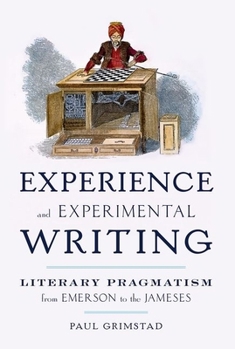
Experience and Experimental Writing: Literary Pragmatism from Emerson to the Jameses
No Customer Reviews

Select Format
Select Condition 
Book Overview
American pragmatism is premised on the notion that to find out what something means, look to fruits rather than roots. But, as Paul Grimstad shows, the thought of the classical pragmatists is itself the fruit of earlier experiments in American literature. Ralph Waldo Emerson, Edgar Allan Poe, Herman Melville, and (contemporaneously with the flowering of pragmatism) Henry James, each in their different ways prefigure at the level of literary form what emerge as the guiding ideas of classical pragmatism. Specifically, this occurs in the way an experimental approach to composition informs the classical pragmatists' central idea that experience is not a matter of correspondence but of an ongoing attunement to process. The link between experience and experiment is thus for Grimstad a way of gauging the deeper intellectual history by which literary experiments--Emerson's Essays; Poe's invention of the detective story in "The Murders in the Rue Morgue;" Melville's Pierre; and Henry James's late style--find their philosophical expression in classical pragmatism. Charles Peirce's notion of the "abductive" inference; William James's "radical empiricism;" and John Dewey's naturalist account of experience inform the book's readings. Experience and Experimental Writing also frames its set of claims in relation to more contemporary debates within literary criticism and philosophy that have so far not been taken up in this context: putting Richard Poirier's account of the relation of pragmatism to literature into dialogue with Stanley Cavell's inheritance of Emerson as someone decidedly not a "pragmatist;" to differences between classical pragmatists like William James and John Dewey and more recent, post-linguistic turn thinkers like Richard Rorty and Robert Brandom.
Format:Paperback
Language:English
ISBN:0190270047
ISBN13:9780190270049
Release Date:December 2015
Publisher:Oxford University Press
Length:208 Pages
Weight:0.65 lbs.
Dimensions:0.5" x 6.1" x 9.1"
Customer Reviews
0 rating
Copyright © 2026 Thriftbooks.com
Terms of Use | Privacy Policy | Do Not Sell/Share My Personal Information | Cookie Policy | Cookie Preferences | Accessibility Statement
ThriftBooks ® and the ThriftBooks ® logo are registered trademarks of Thrift Books Global, LLC
ThriftBooks ® and the ThriftBooks ® logo are registered trademarks of Thrift Books Global, LLC
