


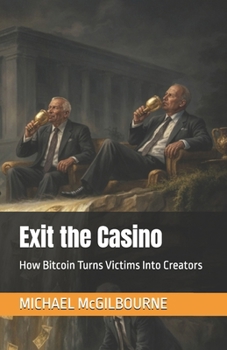
Exit the Casino: How Bitcoin Turns Victims Into Creators

The Rigged Game: Why Fiat Makes You a Victim and Bitcoin Makes You Free
You are not bad with money.
The money is bad.
The gap between how hard you work and how little financial ground you gain is not a personal failing. It is not a consequence of poor decisions, insufficient discipline, or bad luck. It is arithmetic. The predictable, measurable, deliberately engineered consequence of a monetary system that was never designed to serve the people who use it most.
This book is about that system. And about the door out of it.
Most people sense that something is wrong with money. They work harder each year and find that what they earn buys less. They save diligently and watch their savings lose purchasing power in ways the official figures consistently understate. They follow the advice - invest, diversify, trust the process - and still find themselves running to stand still, pushing a boulder up a slope that inflation resets every year.
This book gives that feeling a name. Several names.
The Cantillon Effect - the observation that new money does not distribute evenly. It flows first to those closest to its creation: banks, governments, the institutions at the top of the monetary waterfall. By the time it reaches the ordinary worker's wage, prices have already risen and purchasing power has already been redistributed upward. The wealthy absorb it at the top. Everyone else pays for it at the bottom.
The invisible tax collector - inflation, arriving every month without a bill, without a receipt, without recourse, taking a percentage of everything you have saved and offering nothing in return.
The casino. A casino whose rules were written before you arrived, whose house edge is structural and invisible, and whose most sophisticated design feature is that almost no one inside it recognises it as a casino at all.
Written by Michael McGilbourne - a former London stockbroker, US financial advisor, and foreign exchange risk professional who spent years inside the machinery of institutional finance - this book draws on firsthand experience of what the fiat system looks like from both sides of the line. From currency crises watched in real time on trading terminals, to a Turkish restaurant owner whose savings were hollowed out by lira debasement, to migrant workers in Southeast Asia losing twenty percent of their earnings to remittance fees, the argument is not theoretical. It is grounded in what monetary systems actually do to real people.
But this is not a book of grievance. It is a book of navigation.
Because the moment you see the game clearly - name its mechanisms, understand its architecture - something changes. You stop being a passive victim. You begin to become the creator of your own financial life. And the instrument of that creation is Bitcoin - not as a speculative asset, but as a monetary system governed by fifteen first principles that no government or central bank can override.
Fixed supply. Decentralisation. Censorship resistance. Self-custody. Rules enforced by mathematics rather than by the goodwill of institutions whose interests are not aligned with yours.
This book maps the full psychological journey of that transition - from awakening through disillusionment, through the darkness of the Valley of Tears, to the insight and renewal that genuine financial sovereignty makes possible.
You cannot reform the casino.
But you can walk out of it.
Customer Reviews
ThriftBooks ® and the ThriftBooks ® logo are registered trademarks of Thrift Books Global, LLC
