


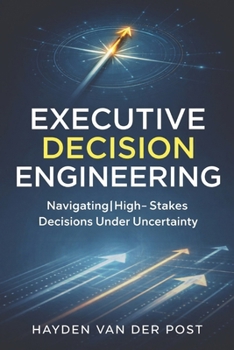
Executive Decision Engineering: Navigating High-Stakes Decisions Under Uncertainty

In volatile environments, the quality of leadership is revealed through decision-making.
Executive Decision Engineering examines how leaders structure judgment when information is incomplete, outcomes are asymmetric, and time is limited. Rather than relying on intuition alone, modern decision-makers increasingly use structured thinking frameworks that allow them to interpret uncertainty without paralysis or overreaction.
This book explores how executives approach complex choices where:
Information is fragmented
Risk cannot be fully quantified
Stakeholder consequences are significant
Delay may carry greater cost than action
Drawing from decision science, strategic management, and real-world leadership dynamics, Executive Decision Engineering outlines how senior leaders:
Frame ambiguity into actionable pathways
Separate signal from noise under pressure
Manage downside exposure while preserving upside potential
Maintain decisiveness without overconfidence
Rather than presenting formulaic prescriptions, this work provides a structural lens into how consequential decisions are actually formed at the highest levels of organizations.
For readers interested in leadership, strategy, and organizational judgment under uncertainty, this book offers a grounded exploration of how critical decisions are shaped when clarity is absent and stakes are real.
Customer Reviews
ThriftBooks ® and the ThriftBooks ® logo are registered trademarks of Thrift Books Global, LLC
