
Skip to content
Scan a barcode
Scan
Paperback Excitable Speech: A Politics of the Performative Book

ISBN: 0367705249

ISBN13: 9780367705244

Excitable Speech: A Politics of the Performative

Select Format

Select Condition ThriftBooks Help Icon

Recommended

Format: Paperback

Condition: New

$32.33
Ships within 2-3 days
Save to List

Book Overview

'When we claim to have been injured by language, what kind of claim do we make?' - Judith Butler, Excitable Speech

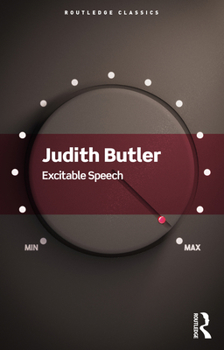
Excitable Speech is widely hailed as a tour de force and one of Judith Butler's most important books. Examining in turn debates about hate speech, pornography and gayness within the US military, Butler argues that words can wound and linguistic violence is its own kind of violence. Yet she also argues that speech is 'excitable' and fluid, because its effects often are beyond the control of the speaker, shaped by fantasy, context and power structures.

In a novel and courageous move, she urges caution concerning the use of legislation to restrict and censor speech, especially in cases where injurious language is taken up by aesthetic practices to diminish and oppose the injury, such as in rap and popular music. Although speech can insult and demean, it is also a form of recognition and may be used to talk back; injurious speech can reinforce power structures, but it can also repeat power in ways that separate language from its injurious power. Skillfully showing how language's oppositional power resides in its insubordinate and dynamic nature and its capacity to appropriate and defuse words that usually wound, Butler also seeks to account for why some clearly hateful speech is taken to be iconic of free speech, while other forms are more easily submitted to censorship.

In light of current debates between advocates of freedom of speech and 'no platform' and cancel culture, the message of Excitable Speech remains more relevant now than ever.

This Routledge Classics edition includes a new Preface by the author, where she considers speech and language in the context contemporary forms of political polarization.

Customer Reviews

3 ratings

Butler and Agency

Butler is a difficult author to understand, particularly if you don't have a background in theories of performativity. I recommend reading JL Austin's How to Do Things with Words and Derrida's Limited, Inc either before or alongside this book. She also draws heavily from Foucault and Althusser. Excitable Speech is powerful for its account of how subjects are formed through the address of hate speech and how, through this very address, the conditions for the subject's agency are enabled. A previous reviewer pointed out that for Butler "the subject can only exhibit agency in and through language" and that agency in Butler's account emerges ex nihilio. This is a misunderstanding of both Butler and poststructural theories of agency in general. For Butler, agency is not produced by an autonomous actor; nor is it contained to language. Drawing from Derrida and Bourdieu, Butler's point is that agency arises from social iterability and the fact that every re-iteration opens the potential for change and subversion. Such iteration, however, is part of the structure of signification broadly conceived (not simply language) and is not the conscious effort of an individual agent. Thus, Butler points to the effect of the body and how bodies are implicated in acts of speech and iteration. In this text Butler is perhaps at her most cogent and most optimistic reach. I would recommend picking this up for anyone serious about theories of performativity.

Butler's most "grounded" work

Butler does a good job grounding speech act theory in political and legal issues, particularly racist and homophobic "hate speech." She takes Derrida's theory of iterability and shows how repetition of discourse in new contexts can be a means of resistance. For Butler, this is very applied and I liked it much better than Gender trouble.

When words injure, what do we do?

An insightful and thoroughly researched study of the social, political, and legal ramification of not only hate speech but discourse concerning the lingusitics of hate. Butler questions the contemporary practices of the adjudication of speech which seeks to define what is correct speech and what is proscribable under law. If words are legally indistinguishable from conduct, then, Butler asks, is law not complicit in the wounds that words cause? Challenging reading
Copyright © 2026 Thriftbooks.com Terms of Use | Privacy Policy | Do Not Sell/Share My Personal Information | Cookie Policy | Cookie Preferences | Accessibility Statement
ThriftBooks ® and the ThriftBooks ® logo are registered trademarks of Thrift Books Global, LLC

GoDaddy Verified and Secured