


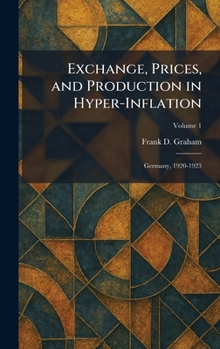
Exchange, Prices, and Production in Hyper-Inflation: Germany, 1920-1923

"Exchange, Prices, and Production in Hyper-Inflation: Germany, 1920-1923" is a definitive economic study exploring one of the most volatile periods in financial history. This work provides a meticulous analysis of the Weimar Republic's descent into hyperinflation and the subsequent effects on international exchange rates, domestic price levels, and industrial production.
Through comprehensive statistical data and theoretical rigor, Frank D. Graham examines the mechanisms that drove the German Mark to total collapse. The book investigates the relationship between the expansion of the money supply and the rapid depreciation of the currency, offering insights into the social and economic consequences of monetary instability. It stands as a crucial resource for understanding the complexities of fiscal policy, the dynamics of price-speculation, and the real-world impact of extreme inflation on a major industrial nation.
This volume is essential reading for economists, historians, and scholars of monetary policy seeking to understand the structural failures and extraordinary circumstances of the post-WWI German economy. It remains a foundational text in the study of economic crises and the interplay between government finance and market stability.
This work has been selected by scholars as being culturally important, and is part of the knowledge base of civilization as we know it. This work was reproduced from the original artifact, and remains as true to the original work as possible. Therefore, you may see the original copyright references, library stamps (as most of these works have been housed in our most important libraries around the world), and other notations in the work.
This work is in the public domain in the United States of America, and possibly other nations. Within the United States, you may freely copy and distribute this work, as no entity (individual or corporate) has a copyright on the body of the work.
As a reproduction of a historical artifact, this work may contain missing or blurred pages, poor pictures, errant marks, etc. Scholars believe, and we concur, that this work is important enough to be preserved, reproduced, and made generally available to the public. We appreciate your support of the preservation process, and thank you for being an important part of keeping this knowledge alive and relevant.
Customer Reviews
ThriftBooks ® and the ThriftBooks ® logo are registered trademarks of Thrift Books Global, LLC
