


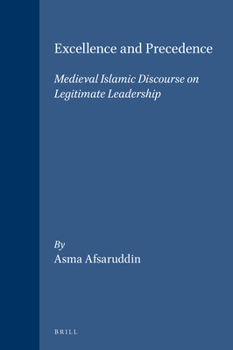
Excellence and Precedence: Medieval Islamic Discourse on Legitimate Leadership
(Part of the Brill's Islamic History and Civilization Series)
No Customer Reviews

This volume focuses on how legitimate leadership came to be defined in the formative period of Islam in terms of two key Qur'anic concepts: moral excellence (faḍl/faḍīla) and precedence (sābiqa). These two concepts undergirded a specific discourse on leadership which developed in the first century of Islam. This discourse is reconstructed through careful scrutiny of the manāqib literature in particular, which contains detailed accounts of the excellences attributed to the Rāshidūn caliphs. This book stresses that all early factions, including the proto-Shī'a, subscribed to the Qur'ānically-mandated vision of a righteous polity guided by its most morally excellent members. Such a conclusion forces us to rethink the nature of leadership in the earliest period and reconsider the criteria invoked to establish its legitimacy.
Format:Hardcover
Language:English
ISBN:9004120432
ISBN13:9789004120433
Release Date:February 2002
Publisher:Brill
Length:324 Pages
Weight:1.61 lbs.
Dimensions:1.1" x 6.6" x 9.6"
Customer Reviews
0 rating
Copyright © 2026 Thriftbooks.com Terms of Use
| Privacy Policy | Do Not
Sell/Share My Personal Information | Cookie Policy | Cookie Preferences | Accessibility Statement
ThriftBooks® and the ThriftBooks® logo are registered trademarks of Thrift Books Global, LLC
ThriftBooks® and the ThriftBooks® logo are registered trademarks of Thrift Books Global, LLC
