


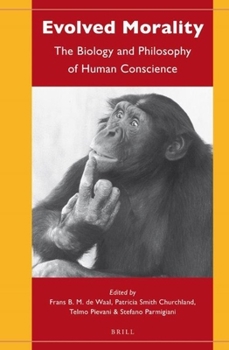
Evolved Morality: The Biology and Philosophy of Human Conscience
No Customer Reviews

Select Format
Select Condition 
Book Overview
Morality is often defined in opposition to the natural "instincts," or as a tool to keep those instincts in check. New findings in neuroscience, social psychology, animal behavior, and anthropology have brought us back to the original Darwinian position that moral behavior is continuous with the social behavior of animals, and most likely evolved to enhance the cooperativeness of society. In this view, morality is part of human nature rather than its opposite. This interdisciplinary volume debates the origin and working of human morality within the context of science as well as religion and philosophy. Experts from widely different backgrounds speculate how morality may have evolved, how it develops in the child, and what science can tell us about its working and origin. They also discuss how to deal with the age-old facts-versus-values debate, also known as the naturalistic fallacy. The implications of this exchange are enormous, as they may transform cherished views on if and why we are the only moral species.
These articles are also published in Behaviour, Volume 151, Nos. 2/3 (February 2014).
Suitable for course adoption
These articles are also published in Behaviour, Volume 151, Nos. 2/3 (February 2014).
Suitable for course adoption
Format:Paperback
Language:English
ISBN:9004268162
ISBN13:9789004268166
Release Date:February 2014
Publisher:Brill
Length:270 Pages
Weight:0.80 lbs.
Dimensions:0.7" x 6.3" x 9.2"
Customer Reviews
0 rating
Copyright © 2026 Thriftbooks.com Terms of Use
| Privacy Policy | Do Not
Sell/Share My Personal Information | Cookie Policy | Cookie Preferences | Accessibility Statement
ThriftBooks® and the ThriftBooks® logo are registered trademarks of Thrift Books Global, LLC
ThriftBooks® and the ThriftBooks® logo are registered trademarks of Thrift Books Global, LLC
