


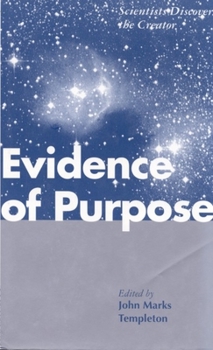
Evidence of Purpose

Select Format
Select Condition 
Book Overview
For nearly a century, the central theological message of science seemed to be that there was no need for theology: science could stand alone to explain the universe. But today, that message is changing. In this volume, a gallery of respected scientists describes new developments in their fields and their relationship with theological views of the universe. Contributors include Owen Gingerich, Russell Stannard, Paul Davies, Walter R. Hearn, Robert Russell, Arthur Peacocke, John Polkinghorne, John C. Eccles, Daniel H. Osmond, and David Wilcox.
Format:Hardcover
Language:English
ISBN:0826406491
ISBN13:9780826406491
Release Date:January 1994
Publisher:Templeton Foundation Press
Length:212 Pages
Weight:1.00 lbs.
Dimensions:0.8" x 6.1" x 9.4"
Age Range:18 years and up
Grade Range:Postsecondary
Customer Reviews
2 ratings
Dare scientists believe in design?
Published by Thriftbooks.com User , 18 years ago
By the middle of the last century, science had at last triumphed over superstition, and science had also, to a degree, put aside the notion that a Creator existed. However, many scientists see no reason to separate the two. Albert Einstein is famously quoted as saying, "Science without religion is blind, and religion without science is lame." This book contains ten thought-provoking essays from scientists who see evidence of design in the universe.
Refuting the argument of the "Blind Watchmaker"
Published by Thriftbooks.com User , 18 years ago
1. "To consider the evidence of purpose, we must define the meaning of cause, for purpose is final cause, one of the four types of cause by Aristole." 2. Final cause is the intended purpose of the maker of the of object 3. Formal cause is the maker's plan or blueprint for the object 4. Material cause is the raw material from which it was made 5. Efficient cause is the force applied to raw material that produces the object. Efficient cause or applied forces is not necessarily a denial of purpose. "When we humans make tools, the shaping forces (efficient cause) act upon the raw materials (material causes) under the direction of our intelligent design or blue print (formal causes) to the tool we intend on making (final cause). A formal cause may by a crystal structure or a parental strand of DNA. "In both human and natural causality, formal cause act as boundary conditions to constrain/direct the force of the efficient cause" - meaning a sphere of influence or intelligent constraint exists. 6. A scientific guess is not a fact: Material causes can't be responsible for creation. The Modern Synthesis of the 1940, stated, "Natural selection is a creator, it builds adaptation step by step." Evolution proponents guest on the means of creation and assumed they were absolutely right. The guess was 100 percent wrong. Lets look at the goals associated with creation. First, we must assume that a template goal or pattern of creation exists. Second, the purpose goal of the final causes does not care about the agent that acts in the gaps between natural processes, but rather, "one who directs them". Third, an immaterial entity acting as a cause for creation offers no proof of a creator. Fourth, if no purpose for creation can be derived than this is analogous to an autonomous material universe. Furthermore, a universe with intent is a universe where the material cause is the product of random and self-organizing patterns of material structures running simple cellular algorithms that form everything and the final cause will be both wise and intelligent. Fifth, we use mental templates or mental remembrances (analogous comparison) to recognize pattern and purpose. "In the case of human artifacts, we recognize purpose against a backdrop of natural purposeless events. We deduce complex formal causes from complex effects, which we detect against a background of alternative simple effects with greater probability." "Without template we can see no utility." Sixth, Asa Grey states, "On the other hand, an omnipotent and omniscient Creator ordains everything and foresees everything. Thus we are brought face-to-face with a difficulty as insoluble as is that of free will and predestination." "Ultimate cause does shape the whole show." 7. The argument of the blind watchmaker is no convincing. Richard Dawkins argues that intelligence is not need in formal cause. "In brief, all living things are the products of specific genomes." DNA, gene mutation, and select
Copyright © 2026 Thriftbooks.com Terms of Use
| Privacy Policy | Do Not
Sell/Share My Personal Information | Cookie Policy | Cookie Preferences | Accessibility Statement
ThriftBooks® and the ThriftBooks® logo are registered trademarks of Thrift Books Global, LLC
ThriftBooks® and the ThriftBooks® logo are registered trademarks of Thrift Books Global, LLC
