


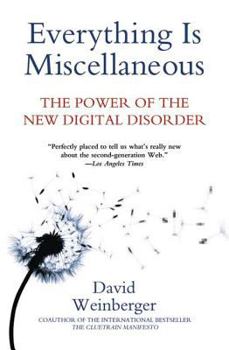
Everything Is Miscellaneous: The Power of the New Digital Disorder

Select Format
Select Condition 
Book Overview
"Perfectly placed to tell us what's really new about the] second-generation Web."--Los Angeles Times
Business visionary and bestselling author David Weinberger charts how as business, politics, science, and media move online, the rules of the physical world--in which everything has a place--are upended. In the digital world, everything has its places, with transformative effects: - Information is now a social asset and should be made public, for anyone to link, organize, and make more valuable. - There's no such thing as "too much" information. More information gives people the hooks to find what they need. - Messiness is a digital virtue, leading to new ideas, efficiency, and social knowledge. - Authorities are less important than buddies. Rather than relying on businesses or reviews for product information, customers trust people like themselves. With the shift to digital music standing as the model for the future in virtually every industry, Everything Is Miscellaneous shows how anyone can reap rewards from the rise of digital knowledge.Format:Paperback
Language:English
ISBN:0805088113
ISBN13:9780805088113
Release Date:April 2008
Publisher:Holt Paperbacks
Length:288 Pages
Weight:0.81 lbs.
Dimensions:0.8" x 5.5" x 8.4"
Customer Reviews
3 ratings
From Aristotle to Del.icio.us
Published by Thriftbooks.com User , 19 years ago
In Brief As other reviewers have mentioned David Weinberger's new book is a hard book to categorize, which is also the irony, since it's central premise is about categorizing information. I place this book in the company of other books about the internet and information; Ambient Findability - Peter Morville, Wikinomics - Don Tapscott, Wealth of Networks - Yochai Benkler. To me it's about the changes wrought by current trends on the internet. Weinberger is deeply familiar with internet and all it's implications, since he is one of the original authors of Cluetrain Manifesto which was probably the first book to outline the game changing nature of the internet. Here he tackles how to cope with the seeming chaos of digital information that we are deluged with. This is a thought provoking book and will make you look at organizing information in a different way. It will help you understand some of the current trends on the internet and put it into historical context. Audience I highly recommend this book for anyone who is interested in internet trends especially as it relates to organizing information. If you are at all interested in the history of information and how we as humans have struggled to come to terms with the world, then this book is one of the best I have come across. It is well written and a pleasure to read. Details David Weinberger, internet visionary, has again synthesized an intellectual romp through another important topic - Information. We, humans, are obsessed with defining, categorizing and organizing information as our way of bringing some order to the chaotic world we live in. Weinberger explores our obsession with information from Plato and Aristotle to our modern-day digital explosion of information. He frames this exploration by defining 3 orders of organizing information: 1) 1st Order organization is of the physical world, manipulating physical objects and organizing them, 2) 2nd Order of organization is the use of metadata to organize and categorize physical objects i.e. library card catalogs. This is still limited by physical constraints. 3) 3rd Order of organization is the world we live in today, as we move from the physical to the digital, organizing information becomes freed from physical constraints allows us to simultaneously define, categorize and organize information into a million different taxonomies. The 1st and 2nd orders of organization are covered as Weinberger explores the history of our obsession with categorizing information; from Plato's `Joints of Nature', to Aristotle's `Trees of Knowledge'. We have been lumping and splitting information for thousands of years. Until recently we have been constrained by the laws of physics, it is hard for objects to be in two places. It is also hard to categorize the real world into orderly taxonomies i.e. what category does a duck-billed-platypus fit into? The 3rd order organization is what Weinberger is referring to in his title, `Everything is Miscellaneo
Playfully profound
Published by Thriftbooks.com User , 19 years ago
I really don't understand what the negative reviewers could possibly have expected from a book about organizing information. I'm currently working on finishing up my Master's in Library Science (and taking my class on organizing information, no less!) With connections the average reader can understand and appreciated, Weinberger explains not only the significance behind the explosion in social tagging, but also the revolution this foments in the information industry. I won't summarize the book's point, as other reviews did that well. I will comment on its implications for education, another one of the top down, authority controlled institutions being threatened by the "common man as expert" phenomenon that is social networking. We've known for a long time that classrooms ought to be student-centered, rather than teacher centered, but we're fighting hundreds of years of tradition. THe kind of miscellany Weinberger describes, when introduced to the classroom through wikis, blogs, and problem-based learning, transforms students into key players in their education, while teachers act as guide and reinforcer. Students work to find structure, make connections and draw conclusions based upon their own findings. Learning is relevant and memorable and skill-based, rather than content based. No wonder the academic, authority-driven powers that be are up in arms about this book!
Much-needed book, but may turn you into a pest
Published by Thriftbooks.com User , 19 years ago
How (and why?) to categorize a book on "miscellaneous"? Info-pop page-turner, maybe? Think Blink but plumbing a deeper set of ideas. Or Freakonomics, but more unified, warm, and funny. Meant to be useful, it succeeds in being much more. What is "miscellanous", when we mean that word in a good way? Big heaps of information, spread out all over the Internet so that its many bits get tagged by many people for different reasons. In the real world of atoms and spacetime. big messes are problems. But a big (virtual) heap of messy data is a good thing--and all the new ways we can add even more information into that mess will make it even more useful. Hyperlinks! Playlists! Statistics! Messy folksonomies! The book (much less miscellanous than my review of it) whacks a much-needed path for a human brain into the hugely "intertwingled" confusion of new possiblities for understanding reality. Now I must warn you about this book's bad side-effect. It is full of "aha!" moments that you'll start quoting to other people. And explaining to them. And since you will probably not explain these ideas with as much humor and clarity as the book does, their eyes may glaze over when you are just getting warmed up. Even if your friends will stand still for your proud impromptu explanation of "Three orders of order," they will probably run when you threaten to read to them out loud its quotes and anecdotes. That's OK. Just tell your friends to go buy their own copies.
Copyright © 2026 Thriftbooks.com
Terms of Use | Privacy Policy | Do Not Sell/Share My Personal Information | Cookie Notice | Cookie Preferences | Accessibility Statement
ThriftBooks ® and the ThriftBooks ® logo are registered trademarks of Thrift Books Global, LLC
ThriftBooks ® and the ThriftBooks ® logo are registered trademarks of Thrift Books Global, LLC
