


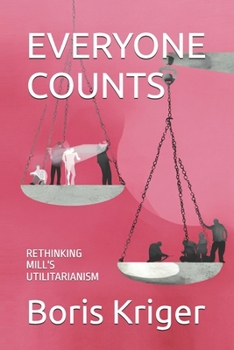
Everyone Counts: Rethinking Mill's Utilitarianism
No Customer Reviews

For two centuries, utilitarianism has promised a simple formula for a better world: the greatest good for the greatest number. It has shaped laws, governments, and the way we think about justice. But baked into its elegant arithmetic is a troubling possibility - that some people are simply rounding errors in the sum of human happiness.
In Everyone Counts: Rethinking Mill's Utilitarianism, Boris Kriger takes on one of philosophy's most enduring debates and proposes a deceptively radical idea: that the aim of morality should not be the happiness of the many at the expense of the few, but the fullest possible flourishing of every individual. Drawing on John Stuart Mill's own writings, the works of Dostoevsky and Ursula Le Guin, Kantian ethics, Greek tragedy, modern psychology, and the infamous trolley problem, Kriger builds a case that utilitarian thinking can be rescued from its darkest implications - but only if we stop treating people as numbers.
Along the way, the book examines how societies systematically distort even the best ideas, turning liberation movements into new orthodoxies, free speech into censorship, and rational governance into bureaucratic theater. Kriger calls this the "crooked lens" effect - and argues that understanding it is the first step toward resisting it.
Written with wit, philosophical rigor, and a refusal to settle for easy answers, Everyone Counts is a book for readers who believe that moral questions deserve better than slogans - and that every person, not just the majority, deserves to be counted.
Keywords: utilitarianism, moral philosophy, John Stuart Mill, individual rights, ethics, political philosophy, freedom
In Everyone Counts: Rethinking Mill's Utilitarianism, Boris Kriger takes on one of philosophy's most enduring debates and proposes a deceptively radical idea: that the aim of morality should not be the happiness of the many at the expense of the few, but the fullest possible flourishing of every individual. Drawing on John Stuart Mill's own writings, the works of Dostoevsky and Ursula Le Guin, Kantian ethics, Greek tragedy, modern psychology, and the infamous trolley problem, Kriger builds a case that utilitarian thinking can be rescued from its darkest implications - but only if we stop treating people as numbers.
Along the way, the book examines how societies systematically distort even the best ideas, turning liberation movements into new orthodoxies, free speech into censorship, and rational governance into bureaucratic theater. Kriger calls this the "crooked lens" effect - and argues that understanding it is the first step toward resisting it.
Written with wit, philosophical rigor, and a refusal to settle for easy answers, Everyone Counts is a book for readers who believe that moral questions deserve better than slogans - and that every person, not just the majority, deserves to be counted.
Keywords: utilitarianism, moral philosophy, John Stuart Mill, individual rights, ethics, political philosophy, freedom
Format:Paperback
Language:English
ISBN:B0GZ4HYG69
ISBN13:9798259466951
Release Date:April 2026
Publisher:Independently Published
Length:220 Pages
Weight:0.66 lbs.
Dimensions:0.5" x 6.0" x 9.0"
Related Subjects
PhilosophyCustomer Reviews
0 rating
Copyright © 2026 Thriftbooks.com
Terms of Use | Privacy Policy | Do Not Sell/Share My Personal Information | Cookie Policy | Cookie Preferences | Accessibility Statement
ThriftBooks ® and the ThriftBooks ® logo are registered trademarks of Thrift Books Global, LLC
ThriftBooks ® and the ThriftBooks ® logo are registered trademarks of Thrift Books Global, LLC
