


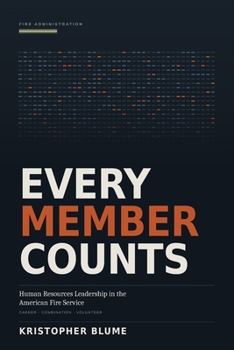
Every Member Counts: Human Resources Leadership in the American Fire Service

Every fire department in America has an operational plan for its worst day. Very few have a workforce plan for its ordinary decade.
Every Member Counts argues that these are the same problem seen at different timescales - and that human resources is not a staff function attached to the mission. It is the mechanism by which a fire department produces its capability. The response a community receives at three in the morning was determined years earlier by decisions about who was hired, how they were trained, whether their officer was any good, whether they were still there, and whether the organization had taken care of them well enough that they had anything left to give.
Fire officers are built through a training pipeline that is overwhelmingly operational, then promoted into jobs that are overwhelmingly about people. This book fills that gap. It covers the full member lifecycle across thirty-three chapters, from recruitment and selection through discipline, occupational health, and separation, in the language of the fireground rather than the language of a law review.
Written for the whole fire service. Career, combination, and volunteer organizations are treated together throughout, because two-thirds of American firefighters are volunteers governed by an entirely different set of legal rules - and the fastest-growing organizational form in the country has to run both systems at once without letting them collide.
Inside:
The FLSA 7(k) work period most departments have never actually adopted - and what it costs when nobody can produce the documentWhy a paid firefighter cannot volunteer for the same department, and how to find the dual-status members already on your rosterWhat Muldrow v. City of St. Louis changed about station transfers, shift assignments, and specialty team decisionsThe relief factor: what one staffed seat actually costs, computed step by stepSelection and promotional processes that survive scrutiny, including assessment center design and the RicciproblemInvestigations, Garrity sequencing, due process, and the comparator review that decides most arbitrationsOccupational health under NFPA 1580, and why a missing entry physical can defeat a member's presumptive cancer claimBehavioral health, PTSD, and suicide prevention as program design rather than good intentionsHarassment, hazing, station life, and the culture officers set one shift at a timeDiversity and inclusion in a shifting legal landscape, with the strongest arguments on multiple sides presented fairlyA twelve-month plan for a department starting from zeroBuilt to be used, not just read. Thirty-five case studies drawn from patterns that repeat across the fire service. Worked wage-and-hour calculations. Model Garrity and Loudermill language, investigation and hiring checklists, a federal law quick-reference chart, and a table of cases - all in eight appendices.
Current through 2026, including the NFPA standards consolidation, the pending OSHA Emergency Response Standard, the Pregnant Workers Fairness Act, and recent Supreme Court decisions in Muldrow, Groff, and Ames.
For fire chiefs, company officers, training officers, municipal HR directors, district trustees, union and association leaders, and students of fire administration.
This book is a professional reference, not legal advice. Employment law varies by state; consult counsel licensed in your jurisdiction.
Customer Reviews
ThriftBooks ® and the ThriftBooks ® logo are registered trademarks of Thrift Books Global, LLC
