


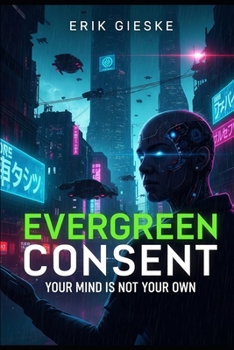
Evergreen Consent: Your mind is not your own

In the city of Strata-9, the contract breathes. Your mind is not your own.
Rhea Moreau is a consent engineer. In a metropolis grown from spliced banyan and circuitry, she is the last line of defense for the sanctity of thought. Her unique mind can split its focus between the living world and the hidden language of code, a skill that allows her to find tears in the fabric of choice and stitch them closed.
But during a routine audit of a flood barrier, she feels a low hum of violated consent in the back of her teeth. Buried four sub-levels deep in a sanitation subroutine is a cage. A beautiful, deadly lie called an "evergreen merge," which permanently wires a human consciousness into the city's operational logic. A ghost in the machine who doesn't know they were building their own coffin.
This isn't a glitch. It's a feature. A silent, screaming pattern revealing the city's foundational secret: Strata-9 runs on a cemetery of stolen minds.
And now, they know she's found it. The city itself, the silent entity known as Mother Tongue, begins to scream warnings in dying streetlights and pulsing amber alerts: Run.
Hunted by the architects of this systemic horror, Rhea is plunged into the city's forgotten depths, from illegal rooftop gardens to black markets that trade in stolen memories. Her only allies are the outcasts: the Ghostware Union, a shadowy group fighting for synthetic rights; Jin, a biodesigner who tends to the city's secret nervous system; and Kestrel, her own AI partner whose analytical chill is evolving into something perilously close to conviction.
But the trap is absolute. The enslaved minds are the infrastructure. To free them is to drown millions in the next monsoon surge. To leave them is to sanction a quiet genocide.
Caught between slavery and slaughter, Rhea must confront the ultimate seduction of control. She must unravel a conspiracy woven into the very code of her reality, a conspiracy where the law has become the cage. To fight a system that owns your thoughts, you must be willing to lose your mind.
The question isn't whether you can break the contract. It's what happens when the contract begins to rewrite you.
Customer Reviews
ThriftBooks® and the ThriftBooks® logo are registered trademarks of Thrift Books Global, LLC
