


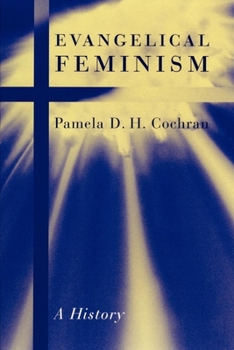
Evangelical Feminism: A History


Select Format
Select Condition 
Book Overview
For most people, the terms "evangelical" and "feminism" are contradictory. "Evangelical" invokes images of conservative Christians known for their strict interpretation of the Bible, as well as their support of social conservatism and traditional gender roles. So how could an evangelical support feminism, a movement that seeks, at its most basic level, to redress the inequalities, injustice, and discrimination that women face because of their sex? Evangelical Feminism offers the first history of the evangelical feminist movement. It traces the emergence and theological development of biblical feminism within evangelical Christianity in the 1970s, how an internal split among members of the movement came about over the question of lesbianism, and what these developments reveal about conservative Protestantism and religion generally in contemporary America. Cochran shows that biblical feminists have been at the center of changes both within evangelicalism and in American culture more broadly by renegotiating the religious symbols which shape its deepest values.
Format:Paperback
Language:English
ISBN:0814716504
ISBN13:9780814716502
Release Date:January 2005
Publisher:New York University Press
Length:245 Pages
Weight:0.80 lbs.
Dimensions:0.7" x 6.0" x 8.9"
Related Subjects
Christian Books & Bibles Christian Living Christianity Church History Churches & Church Leadership Criticism & Theory Evangelism Gender Studies History & Criticism Ministry & Evangelism Politics & Social Sciences Religion Religion & Spirituality Religious Studies Social Sciences Theology Women's Issues Women's StudiesCustomer Reviews
3 ratings
Decent history of feminism in the Protestant movement, but could have been better
Published by Thriftbooks.com User , 16 years ago
The history this book attempts to cover is a fascinating one in terms of the internal struggle within the Protestant world concerning the equality of women in the church and home. It describes the rise of the Evangelical Women's Caucus (now the Evangelical & Ecumenical Women's Caucus), the split within the movement over tolerance of homosexuality, and the formation of the more conservative Christians For Biblical Equality. It focuses in on several key figures within these organizations and explores their personal stories as well as the hermeneutics they utilized to arrive at the conclusion that Christianity and feminism were not antithetical to one another. While the book is generally engaging and well written, I give it four stars out of five because I think it could have been better. For starters, the title is a bit misleading. I expected this to be a history of the more conservative CBE movement. While that is covered, the author spends more of her time on the progressive figures who formed and ultimately stayed with the EWC/EEWC, ultimately admitting at the end of the book that these women are not really "evangelicals" as of the book's writing. Since it devotes so much time to women who ultimately parted ways with evangelicalism, *Protestant Feminism* or *Christian Feminism* probably would have been a more accurate title. I would have liked to have seen more coverage of the rise of the Council on Biblical Manhood and Womanhood as a counter-movement and the reactions of male headship advocates to egalitarian arguments. More interaction with contemporary secular feminist thought would have been good as well, and the book's concluding chapter about how individualism is eroding evangelical Christianity comes off as a rather disjointed, last-minute potshot. Nevertheless, it remains a solid read and a valuable contribution to the field for anyone who wants to learn about this movement within Christianity and a recommended read.
Accessible and needed
Published by Thriftbooks.com User , 19 years ago
A remarkably objective study, considering the contentious subject matter. This book tells the story of incredibly motivated and intelligent Christian feminist women who struggle against what appear to be insurmountable odds to reorient the wide net of a so noted, loudly self-indentified doctrinaire evangelicalism back to biblical equality and social witness. I, even as a liberal Christian, had assumed that a committment to specifically 'evangelical' (with its clear strengths as well as weaknesses) theology could not coexist with deep and meaningful feminist scholarship, activism, and awareness. Put simply, I thought individual women, let alone consortiums, didn't exist in large enough numbers (more like an oppressed diaspora, probably) to actually get books published, reviews in evangelical publications, and sometimes, even teaching positions at stridently 'evangelical' educational outlets. Well, I was wrong, big time. But even as I rejoice in their accomplishments, I am pessemistic as to the long term success of this particular expression of the feminist movement. The leadership of those evangelical denomations, publishing houses, and seminaries has a vested interest in their agenda, in which social conservatism and single issue caucus ideology often trumps the liberating potential of the biblical writings and witness. I know this from experiential knowledge of attending an evangelical college (I went from studying under evangelicals, to community college, to a Jewish studies major - this has naturally divided my religious personality, but despite the 2,000 year old staredown gapping this space, I would do it all over again) for a time. Praying on my approach to these things as well as my own reading and talking to various 'types' of Christian women who are active and intelligent stewards of their personal faith. I'd thought the only refuge for feminist Christians was the liberal churches (they probably still are) but this book makes clear the imperative to stick it out and fight for those for whom the issues raised in this book are their cross to bear, witnessing to a hostile androcentric church system of things. And I speak as a one of those so tasked, and I'm a guy. Either women are equal to men, or they aren't. Can't we make a decision on this already and move on to more important issues that affect our shared future? Though often the author juggles a 'just the facts, m'am' style with the necessary pathos and human interest vignettes that reminds us these are real, flesh and blood women, with the same aspirations, intelligence, and dreams as anyone else. The only criticism I have of the writing style is that I had a difficult time distinguising where the documentary evidence ended and the author's personal opinion began. Fortunately she keeps her overt bias to a minimum, but sometimes she has a style of syntax and presentation that often bleeds into advocacy. This is necessary, I like to know where an author stands on the issues she is a
Evangelical Feminism--A book worth reading for many reasons
Published by Thriftbooks.com User , 21 years ago
I was attracted to this book because of one word - Feminism; but this book is important because of the first word in the title - Evangelical. Cochran skillfully weaves the history of American evangelicalism into the story of biblical feminism. Like salve for my open wounds, I was blessed by Cochran's ability to discuss feminist theological issues honestly. But more importantly, I was blessed by her explanations of evangelicalism. This book is important to the greater Christian community because it places the conversation about biblical feminism within the context of the broader discussion of biblical inerrancy and interpretation. Am I a feminist? Maybe. But no matter the answer to the question, I am equipped to join the ongoing discussion of biblical feminism. No longer will this discussion be divorced from the history of evangelicalism. That is why this book is important. To read a full review of this book go to the following link: http://theotherjournal.com/article.php?id=70
Copyright © 2026 Thriftbooks.com
Terms of Use | Privacy Policy | Do Not Sell/Share My Personal Information | Cookie Policy | Cookie Preferences | Accessibility Statement
ThriftBooks ® and the ThriftBooks ® logo are registered trademarks of Thrift Books Global, LLC
ThriftBooks ® and the ThriftBooks ® logo are registered trademarks of Thrift Books Global, LLC
