


All Formats & Editions
Euthydemus (Focus Philosophical Library)
Euthydemus (Hackett Classics)
"This is the best translation available of a lively and challenging dialogue, which sets before the reader profound questions about the use and misuse of reason." --Myles Burnyeat, University of Cambridge
![Colección Platón: Eutifrón (Spanish Edition) [Spanish] 1548296791 Book Cover](https://m.media-amazon.com/images/I/31pmzA8WStL._SL500_.jpg)
Colección Platón: Eutifrón (Spanish Edition) [Spanish]
![Eutidemo o el disputador [Spanish] 1502960532 Book Cover](https://i.thriftbooks.com/api/imagehandler/l/41FE9F91C717B9097311E800B5CD37020F59542E.jpeg)
Eutidemo o el disputador [Spanish]
"Eutidemo o el disputador", de Plat n. Plat n fue un Fil sofo griego, alumno de S crates y maestro de Arist teles (427 adC - 347 adC)
Euthydemus
Complete and unabridged edition. Euthydemus, written c. 384 BC, is a dialogue by Plato which satirizes what Plato presents as the logical fallacies of the Sophists. In it, Socrates describes to his friend Crito a visit he and various youths paid to two brothers,...
Euthydemus
Euthydemus is a philosophical dialogue written by ancient Greek philosopher Plato. The dialogue takes place between Socrates and two brothers, Euthydemus and Dionysodorus, who are sophists - teachers of rhetoric and argumentation. The dialogue begins with Euthydemus and Dionysodorus...

The Euthydemus of Plato, With an Intr. and Note...
This work has been selected by scholars as being culturally important, and is part of the knowledge base of civilization as we know it. This work was reproduced from the original artifact, and remains as true to the original work as possible. Therefore, you will see the original...
Euthydemus
Euthydemus is a philosophical dialogue written by Plato, believed to have been composed in the late 5th century BCE. The dialogue takes place between Socrates and two sophists, Euthydemus and Dionysodorus, who claim to be able to teach their students the art of winning any argument,...
Euthydemus
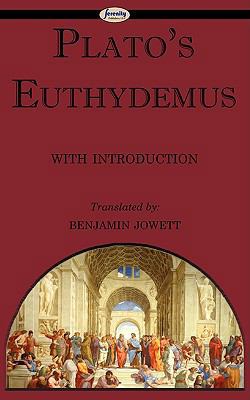
Plato studied under Socrates and was Aristotle's teacher. Together these three Greeks developed the basis of philosophical thinking for the entire Western world. Plato was also a writer, mathematician, and founder of the Academy in Athens, which was the first university in Europe...
Euthydemus (Special Edition for Students)
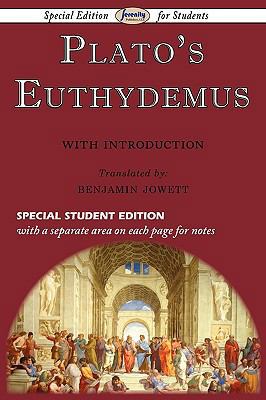
Plato's Euthydemus with Introduction, Translated by Benjamin Jowett. ***Special Student Edition with a separate area on each page for notes.
![The Euthydemus of Plato [Greek, Ancient (to 1453)] 114470930X Book Cover](https://i.thriftbooks.com/api/imagehandler/l/6D383803FA84823B1AB7F08C1172A37E1FCC1155.jpeg)
The Euthydemus of Plato [Greek, Ancient (to 1453)]
![The Euthydemus of Plato - Primary Source Edition [Greek, Ancient (to 1453)] 1295780631 Book Cover](https://i.thriftbooks.com/api/imagehandler/l/D268C880FE34EDD348467DC39E70C67C469A6B2D.jpeg)
The Euthydemus of Plato - Primary Source Edition [Greek, Ancient (to 1453)]
The Euthydemus of Plato, with an Intr. and Note...
Euthydemus
The Euthydemus, though apt to be regarded by us only as an elaborate jest, has also a very serious purpose. It may fairly claim to be the oldest treatise on logic; for that science originates in the misunderstandings which necessarily accompany the first efforts of speculation...
Euthydemus
Euthydemus, written c. 384 BC, is a dialogue by Plato which satirizes what Plato presents as the logical fallacies of the Sophists. In it, Socrates describes to his friend Crito a visit he and various youths paid to two brothers, Euthydemus and Dionysodorus, both of whom were...
Euthydemus: Original Text
HERMOGENES: I should explain to you, Socrates, that our friend Cratylus has been arguing about names; he says that they are natural and not conventional; not a portion of the human voice which men agree to use; but that there is a truth or correctness in them, which is the same...
Euthydemus
HERMOGENES: I should explain to you, Socrates, that our friend Cratylus has been arguing about names; he says that they are natural and not conventional; not a portion of the human voice which men agree to use; but that there is a truth or correctness in them, which is the same...
Euthydemus: Large Print
HERMOGENES: I should explain to you, Socrates, that our friend Cratylus has been arguing about names; he says that they are natural and not conventional; not a portion of the human voice which men agree to use; but that there is a truth or correctness in them, which is the same...
![Euthydemus: Large Print [Large Print] B087SJTT6J Book Cover](https://i.thriftbooks.com/api/imagehandler/l/D9BE8CA68AE55F8B36B7124C7F768A9E60FEAD34.jpeg)
Euthydemus: Large Print [Large Print]
In less than no time you shall hear; for I cannot say that I did not attend-I paid great attention to them, and I remember and will endeavour to repeat the whole story. Providentially I was sitting alone in the dressing-room of the Lyceum where you saw me, and was about to depart;...
Euthydemus
In less than no time you shall hear; for I cannot say that I did not attend-I paid great attention to them, and I remember and will endeavour to repeat the whole story. Providentially I was sitting alone in the dressing-room of the Lyceum where you saw me, and was about to depart;...
Euthydemus Annotated
Euthydemus (Greek: Euthydemos), written c. 384 BC, is a dialogue by Plato which satirizes what Plato presents as the logical fallacies of the Sophists. In it, Socrates describes to his friend Crito a visit he and various youths paid to two brothers, Euthydemus and Dionysodorus,...
ThriftBooks ® and the ThriftBooks ® logo are registered trademarks of Thrift Books Global, LLC
