


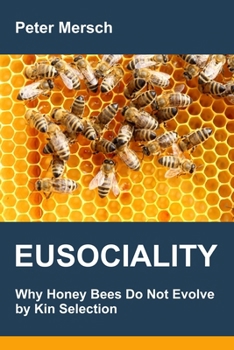
Eusociality: Why Honey Bees Do Not Evolve by Kin Selection
No Customer Reviews

Ricardo's theory of comparative advantage is one of the most fundamental insights in economics. It explains under which conditions division of labor is mutually beneficial, independent of gains from specialization or economies of scale. For this reason, it is sometimes called the law of association.
In this book, Ricardo's theorem is first translated into a more intuitive, competence-based formulation grounded in the fundamental assumption of the Competence-based Theory of Evolution. This reformulation makes the theorem significantly easier to generalize and apply beyond the classic two-actor, two-good case.
The competence-based version of Ricardo's theorem is then applied to the eusocial organization of insect colonies. The results align with biological observation but differ markedly from the explanations offered by established evolutionary biology, particularly inclusive fitness theory (kin selection). The analysis suggests that the latter cannot adequately account for the evolution and stability of eusocial systems. Franz Josef Radermacher, Professor of Mathematics and Computer Science, Member of the Club of Rome on Competence-based Theory of Evolution:
"This is an outstanding work. It offers a comprehensive exploration of the concept of evolution, encompassing general superorganisms, including businesses, states, and all of humanity - a theme that has always been of particular importance to me." Gerhard Vollmer, Professor of Physics and Philosophy, Co-Founder of Evolutionary Epistemology on Competence-based Theory of Evolution:
"It seems to me that this is the best generalization of the concept of evolution so far."
In this book, Ricardo's theorem is first translated into a more intuitive, competence-based formulation grounded in the fundamental assumption of the Competence-based Theory of Evolution. This reformulation makes the theorem significantly easier to generalize and apply beyond the classic two-actor, two-good case.
The competence-based version of Ricardo's theorem is then applied to the eusocial organization of insect colonies. The results align with biological observation but differ markedly from the explanations offered by established evolutionary biology, particularly inclusive fitness theory (kin selection). The analysis suggests that the latter cannot adequately account for the evolution and stability of eusocial systems. Franz Josef Radermacher, Professor of Mathematics and Computer Science, Member of the Club of Rome on Competence-based Theory of Evolution:
"This is an outstanding work. It offers a comprehensive exploration of the concept of evolution, encompassing general superorganisms, including businesses, states, and all of humanity - a theme that has always been of particular importance to me." Gerhard Vollmer, Professor of Physics and Philosophy, Co-Founder of Evolutionary Epistemology on Competence-based Theory of Evolution:
"It seems to me that this is the best generalization of the concept of evolution so far."
Format:Paperback
Language:English
ISBN:B0F8W2JKGT
ISBN13:9798284052495
Release Date:May 2025
Publisher:Independently Published
Length:232 Pages
Weight:0.70 lbs.
Dimensions:0.5" x 6.0" x 9.0"
Customer Reviews
0 rating
Copyright © 2026 Thriftbooks.com
Terms of Use | Privacy Policy | Do Not Sell/Share My Personal Information | Cookie Notice | Cookie Preferences | Accessibility Statement
ThriftBooks ® and the ThriftBooks ® logo are registered trademarks of Thrift Books Global, LLC
ThriftBooks ® and the ThriftBooks ® logo are registered trademarks of Thrift Books Global, LLC
