


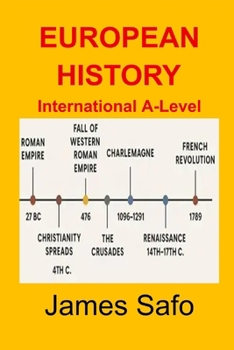
European History: International A Level
No Customer Reviews

Welcome to European History for A Level. This book is an A-level student guide through 500 years of European change, from Renaissance ideas to modern politics.
History is not just the story of kings, battles, and treaties. It is the story of people, of choices made in moments of crisis, of ideas that changed the world, and of ordinary lives caught in extraordinary times.
My goal is simple: to make complex history clear, to teach you how to analyse sources, and to help you author essays that get top marks.
This book, European History for A Level, was written for students who want more than dates to memorise. History is about evidence, argument, and understanding. Each chapter gives you the facts, the context, and the tools to evaluate them. It was written for students who want to understand why Europe became what it is today. The A Level course asks big questions: Why did revolutions happen? Why did empires rise and fall? How did war, ideology, and faith shape the continent from the Renaissance to the present day? In these pages you will find: Clear explanations of key events from 1500 to the present, with focus on causes, consequences, and significance Source analysis and essay skills to help you think like a historian, not just recall facts Connections across countries - because European history cannot be understood by looking at one nation alone Debates and interpretations so you can form your own judgment and write stronger exam answers Whether you are studying the Tudors, the French Revolution, the Cold War, or the making of the European Union, the aim is the same: to give you the knowledge, skills, and confidence to succeed at A Level and beyond. History demands challenging work. But it also rewards curiosity. If you read with an open mind, ask questions, and argue with the evidence, this subject will change how you see the world. Example
The Age of Revolution (1774-1815): the American War of Independence and the spread of Enlightenment ideas destabilised the Ancient R gime in France, producing the Revolution of 1789, the experiments in constitutional monarchy, republic, terror and directory of the 1790s, and finally the rise, empire and fall of Napoleon Bonaparte (Paper 1/2, Topic 1). This period established the ideas of popular sovereignty, nationalism, and citizenship that would shape the rest of the nineteenth century across Europe.
The Age of Restoration and Nationalism (1815-1871):
Tsarist and Revolutionary Russia (1881-1924):
The Road to War (c.1890-1914):
The Age of Dictators (1919-1941):
1919 - Paris Peace Conference; Treaty of Versailles;
1924 - Death of Lenin; murder of Matteotti in Italy
1928 - First Soviet Five-Year Plan begins
1929-33 - Nazi rise from marginal party to power amid the Depression
30 January 1933 - Hitler appointed Chancellor of Germany
30 June 1934 - Night of the Long Knives
1939 - Nazi-Soviet Pact; invasion of Poland; outbreak of the Second World War
1940 - Italy enters the Second World War
1941 - Operation Barbarossa: Germany invades the Soviet Union
History will change how you see the world. I dedicate this book to every student who believes that understanding the past is the best way to build the future.
I dedicate this book to every student who believes that understanding the past is the best way to build the future.
History is not just the story of kings, battles, and treaties. It is the story of people, of choices made in moments of crisis, of ideas that changed the world, and of ordinary lives caught in extraordinary times.
My goal is simple: to make complex history clear, to teach you how to analyse sources, and to help you author essays that get top marks.
This book, European History for A Level, was written for students who want more than dates to memorise. History is about evidence, argument, and understanding. Each chapter gives you the facts, the context, and the tools to evaluate them. It was written for students who want to understand why Europe became what it is today. The A Level course asks big questions: Why did revolutions happen? Why did empires rise and fall? How did war, ideology, and faith shape the continent from the Renaissance to the present day? In these pages you will find: Clear explanations of key events from 1500 to the present, with focus on causes, consequences, and significance Source analysis and essay skills to help you think like a historian, not just recall facts Connections across countries - because European history cannot be understood by looking at one nation alone Debates and interpretations so you can form your own judgment and write stronger exam answers Whether you are studying the Tudors, the French Revolution, the Cold War, or the making of the European Union, the aim is the same: to give you the knowledge, skills, and confidence to succeed at A Level and beyond. History demands challenging work. But it also rewards curiosity. If you read with an open mind, ask questions, and argue with the evidence, this subject will change how you see the world. Example
The Age of Revolution (1774-1815): the American War of Independence and the spread of Enlightenment ideas destabilised the Ancient R gime in France, producing the Revolution of 1789, the experiments in constitutional monarchy, republic, terror and directory of the 1790s, and finally the rise, empire and fall of Napoleon Bonaparte (Paper 1/2, Topic 1). This period established the ideas of popular sovereignty, nationalism, and citizenship that would shape the rest of the nineteenth century across Europe.
The Age of Restoration and Nationalism (1815-1871):
Tsarist and Revolutionary Russia (1881-1924):
The Road to War (c.1890-1914):
The Age of Dictators (1919-1941):
1919 - Paris Peace Conference; Treaty of Versailles;
1924 - Death of Lenin; murder of Matteotti in Italy
1928 - First Soviet Five-Year Plan begins
1929-33 - Nazi rise from marginal party to power amid the Depression
30 January 1933 - Hitler appointed Chancellor of Germany
30 June 1934 - Night of the Long Knives
1939 - Nazi-Soviet Pact; invasion of Poland; outbreak of the Second World War
1940 - Italy enters the Second World War
1941 - Operation Barbarossa: Germany invades the Soviet Union
History will change how you see the world. I dedicate this book to every student who believes that understanding the past is the best way to build the future.
I dedicate this book to every student who believes that understanding the past is the best way to build the future.
Format:Paperback
Language:English
ISBN:1917753527
ISBN13:9781917753524
Release Date:August 2026
Publisher:Faith United Ltd
Length:304 Pages
Weight:0.90 lbs.
Dimensions:0.6" x 6.0" x 9.0"
Related Subjects
HistoryCustomer Reviews
0 rating
Copyright © 2026 Thriftbooks.com
Terms of Use | Privacy Policy | Do Not Sell/Share My Personal Information | Cookie Policy | Cookie Preferences | Accessibility Statement
ThriftBooks ® and the ThriftBooks ® logo are registered trademarks of Thrift Books Global, LLC
ThriftBooks ® and the ThriftBooks ® logo are registered trademarks of Thrift Books Global, LLC
