


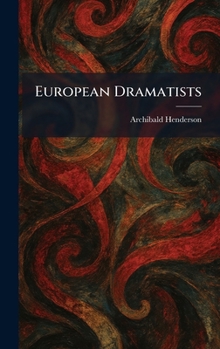
European Dramatists

Select Format
Select Condition 
Book Overview
"European Dramatists" is a significant work of literary criticism that examines the figures who fundamentally reshaped the landscape of modern theater. Written by the esteemed biographer and critic Archibald Henderson, this collection provides an in-depth analysis of the pioneering playwrights whose innovations in style, structure, and theme defined the dramatic arts at the turn of the twentieth century.
The volume features detailed essays on several of the most influential voices in drama, including Henrik Ibsen, August Strindberg, Maurice Maeterlinck, Oscar Wilde, George Bernard Shaw, and Granville Barker. Henderson explores how these artists moved beyond traditional forms to embrace realism, symbolism, and social critique, thereby transforming the stage into a venue for profound psychological and philosophical exploration. By evaluating their contributions to world literature, the book offers readers a clear understanding of the movements that led to the birth of the modern stage.
With its scholarly depth and engaging prose, "European Dramatists" remains a valuable resource for anyone interested in the evolution of the theater. It serves as an essential guide to the intellectual and artistic currents that continue to influence contemporary playwriting and performance.
This work has been selected by scholars as being culturally important, and is part of the knowledge base of civilization as we know it. This work was reproduced from the original artifact, and remains as true to the original work as possible. Therefore, you may see the original copyright references, library stamps (as most of these works have been housed in our most important libraries around the world), and other notations in the work.
This work is in the public domain in the United States of America, and possibly other nations. Within the United States, you may freely copy and distribute this work, as no entity (individual or corporate) has a copyright on the body of the work.
As a reproduction of a historical artifact, this work may contain missing or blurred pages, poor pictures, errant marks, etc. Scholars believe, and we concur, that this work is important enough to be preserved, reproduced, and made generally available to the public. We appreciate your support of the preservation process, and thank you for being an important part of keeping this knowledge alive and relevant.
Customer Reviews
ThriftBooks® and the ThriftBooks® logo are registered trademarks of Thrift Books Global, LLC
