


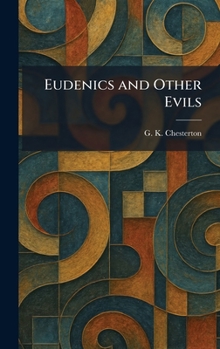
Eudenics and Other Evils

"Eudenics and Other Evils" is a profound and wit-filled critique of the eugenics movement and the encroachment of the state on individual liberties. G.K. Chesterton, one of the most celebrated thinkers of the early twentieth century, examines the moral and social implications of pseudo-scientific trends, arguing that such measures represent a fundamental threat to human dignity and personal freedom.
The work delves into the intersection of law, science, and class, highlighting how eugenicist policies often targeted the poor and marginalized under the guise of social progress. Chesterton's arguments extend beyond a mere rejection of biological determinism; he offers a broader defense of the family unit and the traditional rights of the individual against what he terms the "tyranny of the expert."
Through a series of compelling essays, "Eudenics and Other Evils" remains a significant contribution to social and political philosophy. It challenges readers to consider the ethical boundaries of scientific authority and the importance of protecting the most vulnerable members of society from institutional overreach. This work continues to be relevant for its passionate advocacy for common sense, logic, and the intrinsic worth of every human life.
This work has been selected by scholars as being culturally important, and is part of the knowledge base of civilization as we know it. This work was reproduced from the original artifact, and remains as true to the original work as possible. Therefore, you may see the original copyright references, library stamps (as most of these works have been housed in our most important libraries around the world), and other notations in the work.
This work is in the public domain in the United States of America, and possibly other nations. Within the United States, you may freely copy and distribute this work, as no entity (individual or corporate) has a copyright on the body of the work.
As a reproduction of a historical artifact, this work may contain missing or blurred pages, poor pictures, errant marks, etc. Scholars believe, and we concur, that this work is important enough to be preserved, reproduced, and made generally available to the public. We appreciate your support of the preservation process, and thank you for being an important part of keeping this knowledge alive and relevant.
Customer Reviews
ThriftBooks ® and the ThriftBooks ® logo are registered trademarks of Thrift Books Global, LLC
