
Skip to content
Scan a barcode
Scan
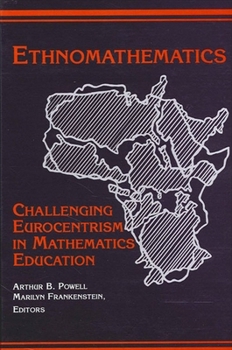
Paperback Ethnomathematics: Challenging Eurocentrism in Mathematics Education Book

ISBN: 0791433528

ISBN13: 9780791433522

Ethnomathematics: Challenging Eurocentrism in Mathematics Education

Select Format

Select Condition ThriftBooks Help Icon

Recommended

Format: Paperback

Condition: New

$37.95
Ships within 2-3 days
Save to List

Book Overview

Presents the emerging field of ethnomathematics from a critical perspective, challenging particular ways in which Eurocentrism permeates mathematics education and mathematics in general.

This collection brings together classic, previously published articles and new research to present the emerging field of ethnomathematics from a critical perspective, challenging particular ways in which Eurocentrism permeates mathematics education. The contributors identify several of the field's broad themes-reconsidering what counts as mathematical knowledge, considering interactions between culture and mathematical knowledge, and uncovering hidden and distorted histories of mathematical knowledge. The book offers a diversity of ethnomathematics perspectives that develop both theoretical and practical issues from various disciplines including mathematics, mathematics education, history, anthropology, cognitive psychology, feminist studies, and African studies written by authors from Brazil, England, Australia, Mozambique, Palestine, Belgium, and the United States.

Customer Reviews

3 ratings

A Purposeful Activity

While it is the 'business' of mathematics to come to 'true' statements, just as it is the business of science to find and record facts, the methods by which we arrive at those facts and truth statements are largely founded upon developments of Western Thinking. The aim of Ethnomathematics is to allow for a dialogue of the various ways by which cultures quantify, and qualify knowledge, and as such it offers a major field of study not only towards intercultural relations, but into the application and practice of mathematics as a whole. For any other jokers out there who would like to argue the primacy or our Western approach to mathematics I point to the following: Ramanujan, the the Mangetu use of Fractals (a practice predating our Western 'discovery'), the Mayan calendar system (not only a way of looking at time but deemed more accurate by many researchers), and how various practices are employed within their respective societies. Finally I would like to point out that ethnomathematics is still a contested field of research, but not because a triangle has three sides, nor because mathematics is 'objective.' That said... While I do not own this book and have not read it in its entirety, I found what I had read of it to be insightful, and well researched. I am writing 5 stars for this book as a purposeful activity to counter what I feel were attacks made out of ignorance and a knee jerk reaction to anything remotely PC.

Agreement with Eduardo.

I must agree with Eduardo's analysis. It is obvious that the two anonymous reviewers have not read the book, nor have any interest in trying to understand the viewpoints presented in the book. If they had, they would have presented some sort of reasoned argument. Disregard the anonymous reviewers. Read the book. Make your own decision. Or base your choice of buying (or reading) the book based on Eduardo's analysis. I am giving the book 5 stars as a counterpoint to the uninformed 1-star ratings given by the other two "reviewers".

Excellent: Mathematics educators must read/study the text

Drs. Powell and Frankenstein have written an excellent reference for mathematics educators. The book presents a well documented argument in favor of teaching mathematics from a multicultural perspective. The chapter on Marx and Mathematics was of particular interest to me because many students of calculus do not know about Marx's interest in the development of the derivative. The book also points out that it is important for students to know that the genesis of mathematics began in Africa. The book includes a comprehensive list of bibliographical references. In my opinion, this book receives an "A". Mathematicians, mathematics educators, and practitioners of mathematics should carefully study the text. I will definitely recommend this book to my colleagues. Skeptics and proponents of ethnomathematics would benefit from this book. This is an excellent piece of literature in the field of mathematics education and ethnomathematics.Dr. Eduardo Arismendi-Pardi, Professor of Mathematics, Orange Coast College, 2701 Fairview Road, P. O. Box 5005, Costa Mesa, California 92628-5005.
Copyright © 2026 Thriftbooks.com Terms of Use | Privacy Policy | Do Not Sell/Share My Personal Information | Cookie Policy | Cookie Preferences | Accessibility Statement
ThriftBooks® and the ThriftBooks® logo are registered trademarks of Thrift Books Global, LLC

GoDaddy Verified and Secured