


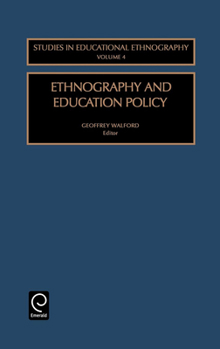
Ethnography and Education Policy
No Customer Reviews

This book emphasises the central place that ethnographic work should have in the formulation and evaluation of education policy. Ethnographic studies contribute to a greater understanding of the process formulation, evaluation and critique. First, careful studies of policy initiatives at the local level can show the extent to which change actually occurs in practice. Second, ethnographic studies can investigate the unintended consequences as well as those planned by the policy. Third, ethnography can investigate the effects of policies in such a way that contradictions within the original policy itself are illuminated. As well as studying the effects and impact of policy, ethnography can also be useful in the formulation of new policies. The various chapters gathered together here give many examples of the ways that ethnography can trace the effects of particular policy developments and may be able to influence future policy debates. The contributors and case studies relate to several countries including the United States, Italy, England, France, Sweden and Switzerland, showing not only that ethnographic research in education is now widespread, but also increasing relevance to policy.
Format:Hardcover
Language:English
ISBN:0762307684
ISBN13:9780762307685
Release Date:March 2001
Publisher:Jai Press Inc.
Length:288 Pages
Weight:1.28 lbs.
Dimensions:0.7" x 6.1" x 9.2"
Customer Reviews
0 rating
Copyright © 2026 Thriftbooks.com Terms of Use
| Privacy Policy | Do Not
Sell/Share My Personal Information | Cookie Policy | Cookie Preferences | Accessibility Statement
ThriftBooks® and the ThriftBooks® logo are registered trademarks of Thrift Books Global, LLC
ThriftBooks® and the ThriftBooks® logo are registered trademarks of Thrift Books Global, LLC
