


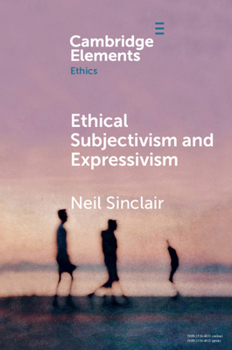
Ethical Subjectivism and Expressivism
No Customer Reviews

Ethical subjectivists hold that moral judgements are descriptions of our attitudes. Expressivists hold that they are expressions of our attitudes. These views cook with the same ingredients - the natural world, and our reactions to it - and have similar attractions. This Element assesses each of them by considering whether they can accommodate three central features of moral practice: the practicality of moral judgements, the phenomenon of moral disagreement, and the mind-independence of some moral truths. In the process, several different versions of subjectivism are distinguished (simple, communal, idealising, and normative) and key expressivist notions such as 'moral attitudes' and 'expression' are examined. Different meanings of 'subjective' and 'relative' are examined and it is considered whether subjectivism and expressivism make ethics 'subjective' or 'relative' in each of these senses.
Format:Paperback
Language:English
ISBN:1108706517
ISBN13:9781108706513
Release Date:September 2020
Publisher:Cambridge University Press
Length:86 Pages
Weight:0.28 lbs.
Dimensions:0.2" x 6.0" x 9.0"
Related Subjects
PhilosophyCustomer Reviews
0 rating
Copyright © 2026 Thriftbooks.com Terms of Use
| Privacy Policy | Do Not
Sell/Share My Personal Information | Cookie Policy | Cookie Preferences | Accessibility Statement
ThriftBooks® and the ThriftBooks® logo are registered trademarks of Thrift Books Global, LLC
ThriftBooks® and the ThriftBooks® logo are registered trademarks of Thrift Books Global, LLC
