


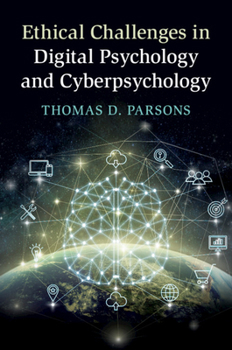
Ethical Challenges in Digital Psychology and Cyberpsychology
No Customer Reviews

Select Format
Select Condition 
Book Overview
Our technologies are progressively developing into algorithmic devices that seamlessly interface with digital personhood. This text discusses the ways in which technology is increasingly becoming a part of personhood and the resulting ethical issues. It extends upon the framework for a brain-based cyberpsychology outlined by the author's earlier book Cyberpsychology and the Brain: The Interaction of Neuroscience and Affective Computing (Cambridge, 2017). Using this framework, Thomas D. Parsons investigates the ethical issues involved in cyberpsychology research and praxes, which emerge in algorithmically coupled people and technologies. The ethical implications of these ideas are important as we consider the cognitive enhancements that can be afforded by our technologies. If people are intimately linked to their technologies, then removing or damaging the technology could be tantamount to a personal attack. On the other hand, algorithmic devices may threaten autonomy and privacy. This book reviews these and other issues.
Format:Paperback
Language:English
ISBN:1108451039
ISBN13:9781108451031
Release Date:November 2019
Publisher:Cambridge University Press
Length:356 Pages
Weight:1.20 lbs.
Dimensions:0.6" x 5.9" x 8.9"
Related Subjects
PsychologyCustomer Reviews
0 rating
Copyright © 2026 Thriftbooks.com Terms of Use
| Privacy Policy | Do Not
Sell/Share My Personal Information | Cookie Policy | Cookie Preferences | Accessibility Statement
ThriftBooks® and the ThriftBooks® logo are registered trademarks of Thrift Books Global, LLC
ThriftBooks® and the ThriftBooks® logo are registered trademarks of Thrift Books Global, LLC
