


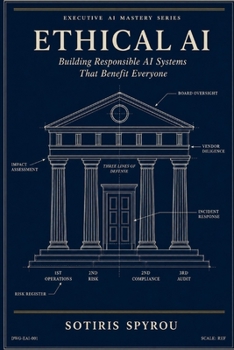
Ethical AI: Building Responsible AI Systems That Benefit Everyone (Executive AI Mastery)
No Customer Reviews

In February 2024 a Canadian tribunal held Air Canada liable for what its chatbot had told a passenger. The airline argued the chatbot was a separate legal entity. The tribunal disagreed. Within eighteen months the same question was being asked in courts in the European Union, the United States, Singapore, and Australia.
Ethical AI is the practical governance reference for the executive who has to answer when the model goes wrong. Not a philosophy book. Not an academic survey. A working guide for the board director, C-suite executive, general counsel, or risk officer whose organisation has deployed AI faster than it has built the apparatus to govern it. Eighteen chapters across five parts: The governance problem - accountability, the regulatory map, what "ethical AI" actually meansHow AI systems fail - bias, explainability, privacy, agentic and safety-critical systemsBuilding a governance posture - risk register, three lines of defence, vendor diligence, incident responseLiving regulations - the EU AI Act in practice, the US patchwork, cross-border conflictsHard questions you cannot avoid - worker dignity, whose values, the Zero Harm baseline
Anchored throughout in real cases (Moffatt v. Air Canada, COMPAS, SyRI, Robodebt, Mobley v. Workday, SCHUFA, the Italian Garante orders, the New York Times litigation) and the regulations the reader is actually subject to: EU AI Act, NIST AI RMF, ISO 42001, GDPR Article 22, Colorado AI Act, NYC Local Law 144.
Format:Paperback
Language:English
ISBN:B0H1QGS4BF
ISBN13:9798196776908
Release Date:August 2025
Publisher:Independently published
Length:243 Pages
Weight:0.73 lbs.
Dimensions:9.0" x 0.6" x 6.0"
Customer Reviews
0 rating
Copyright © 2026 Thriftbooks.com
Terms of Use | Privacy Policy | Do Not Sell/Share My Personal Information | Cookie Notice | Cookie Preferences | Accessibility Statement
ThriftBooks ® and the ThriftBooks ® logo are registered trademarks of Thrift Books Global, LLC
ThriftBooks ® and the ThriftBooks ® logo are registered trademarks of Thrift Books Global, LLC
