


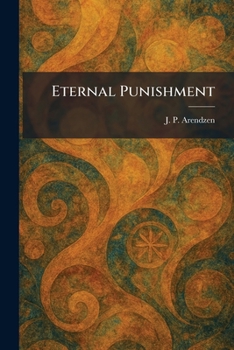
Eternal Punishment

Select Format
Select Condition 
Book Overview
"Eternal Punishment" is a rigorous and insightful exploration of one of the most challenging doctrines in Christian theology: the nature and reality of the afterlife. Written by the esteemed theologian Reverend J.P. Arendzen, this work delves deep into the scriptural, historical, and philosophical foundations of the traditional teaching on Hell and divine retribution.
The book provides a systematic defense of the doctrine of eternal punishment, contextualizing it within the broader framework of God's justice and mercy. Arendzen carefully examines the testimony of the New Testament, the writings of the Early Church Fathers, and the consensus of the scholastic tradition to clarify the Church's position. He addresses the psychological and moral objections often raised against the concept of eternal damnation, offering a thoughtful response that emphasizes the gravity of human free will and the ultimate consequences of rejecting the divine.
This work serves as a significant resource for students of eschatology, philosophy, and Catholic thought. By presenting a clear and uncompromising view of the "Last Things," "Eternal Punishment" remains a compelling study for readers seeking to understand the historical and theological justifications for this foundational aspect of Christian belief. It is a profound meditation on the eternal destiny of the soul and the delicate balance between divine love and the moral order of the universe.
This work has been selected by scholars as being culturally important, and is part of the knowledge base of civilization as we know it. This work was reproduced from the original artifact, and remains as true to the original work as possible. Therefore, you may see the original copyright references, library stamps (as most of these works have been housed in our most important libraries around the world), and other notations in the work.
This work is in the public domain in the United States of America, and possibly other nations. Within the United States, you may freely copy and distribute this work, as no entity (individual or corporate) has a copyright on the body of the work.
As a reproduction of a historical artifact, this work may contain missing or blurred pages, poor pictures, errant marks, etc. Scholars believe, and we concur, that this work is important enough to be preserved, reproduced, and made generally available to the public. We appreciate your support of the preservation process, and thank you for being an important part of keeping this knowledge alive and relevant.
Customer Reviews
ThriftBooks ® and the ThriftBooks ® logo are registered trademarks of Thrift Books Global, LLC
