


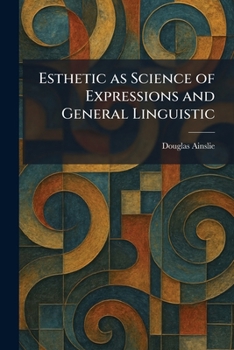
Esthetic as Science of Expressions and General Linguistic

Select Format
Select Condition 
Book Overview
"Esthetic as Science of Expressions and General Linguistic" is a landmark work that explores the profound connection between the nature of art and the structure of language. Through a rigorous philosophical lens, this work posits that the aesthetic experience is not merely a matter of sensory pleasure but a fundamental form of intuitive knowledge. By identifying aesthetics with the science of expression, the text argues that every true intuition is also an expression, effectively bridging the gap between the internal creative impulse and the external artistic manifestation.
The book delves into the historical evolution of aesthetic thought, critiquing traditional theories of beauty while proposing a revolutionary framework that views art as a universal linguistic process. It examines how human expression serves as the primary tool for understanding the world, placing art at the center of intellectual and emotional life. This comprehensive study is essential for those interested in the philosophy of art, the mechanics of language, and the history of modern thought. It remains a vital contribution to our understanding of how we perceive, create, and communicate meaning through the various forms of human expression.
This work has been selected by scholars as being culturally important, and is part of the knowledge base of civilization as we know it. This work was reproduced from the original artifact, and remains as true to the original work as possible. Therefore, you may see the original copyright references, library stamps (as most of these works have been housed in our most important libraries around the world), and other notations in the work.
This work is in the public domain in the United States of America, and possibly other nations. Within the United States, you may freely copy and distribute this work, as no entity (individual or corporate) has a copyright on the body of the work.
As a reproduction of a historical artifact, this work may contain missing or blurred pages, poor pictures, errant marks, etc. Scholars believe, and we concur, that this work is important enough to be preserved, reproduced, and made generally available to the public. We appreciate your support of the preservation process, and thank you for being an important part of keeping this knowledge alive and relevant.
Customer Reviews
ThriftBooks ® and the ThriftBooks ® logo are registered trademarks of Thrift Books Global, LLC
