


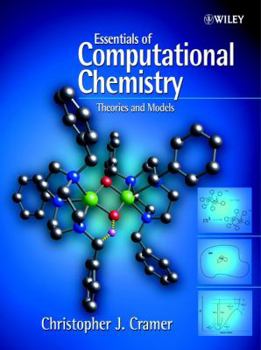
Essentials of Computational Chemistry: Theories and Models


Select Format
Select Condition 
Book Overview
Throughout chemistry, computational techniques are becoming increasingly important. Problem solving and modelling is quickly achievable but as the power of computers increases so does the complexity of the tasks and the speed at which they are solved. A basic understanding of the theory and concepts underpinning computational chemistry is therefore essential to all chemical science students, and Essentials of Computational Chemistry: Theory and Models delivers a thorough insight in a readable and approachable manner. * Accessible as a text to advanced undergraduate students as well as graduate students * Emphasises the basic concepts and applications rather than theory and mathematics * Firmly places the subject in context, including many examples and applications * Includes coverage and examples from inorganic, organic and biological chemistry and covers quantum mechanical and classical mechanical models * Includes case histories that serve as an ideal basis for classroom discussion * Delivers information in a readable and approachable manner
Format:Paperback
Language:English
ISBN:0471485527
ISBN13:9780471485520
Release Date:April 2002
Publisher:Wiley
Length:562 Pages
Weight:2.15 lbs.
Dimensions:9.7" x 1.2" x 6.6"
Customer Reviews
3 ratings
An Overview of Computational Chemistry
Published by Thriftbooks.com User , 18 years ago
A good overview of Computational Chemistry. Nevertheless, one cannot expect to learn Hartree-Fock or Density Functional Theory from this book alone. That is why I rated it four stars.
great introduction book
Published by Thriftbooks.com User , 22 years ago
I don't have really much more than this to say. It is a great introduction book to computationnal chemistry. I basically learnt computationnal chemistry with this book alone. Everything is well explained and for the ones interested in the mathematics behind this science there is a very good overlook. For advanced topics another book should be used, but it is the ideal book for a first contact with this topic. I have recommended this book to a person who work with me and she realy appreciated this book too.
Chemistry by computers: an excellent introduction
Published by Thriftbooks.com User , 23 years ago
Cramers' book is an excellent introduction to the field of computational chemistry. The book is organized in 15 chapters. Chapter 1 gives you a general overview on the interplay between Theory, Computation and Modeling. The next two chapters are devoted to molecular mechanics (ch. 2) and to simulation of molecular ensembles (ch. 3), namely molecular dynamics and Monte Carlo methods, which are necessary for a better understanding of later chapters on condensed phases (see ch. 11 and 12). Note, however, that quantum chemical methods are the main subject of this book and if you want to learn more about molecular simulation (i.e. force field-based methods), you will need to consult books like Frenkel & Smit's "Understanding Molecular Simulation" or else. Chapter 4 lays the foundations of molecular orbital (MO) theory and is closely followed by ch. 5 (semiempirical methods) and 6 (ab initio Hartree-Fock MO method). Electron correlation methods are discussed in ch. 7 while ch. 8 is devoted to density functional theory (DFT), whose merits and demerits in solving molecular problems are being compared to MO theory (cf. paragraph 8.5). The remaining six chapters discuss about charge distribution and spectroscopic properties (ch. 9), thermodynamic properties (ch. 10), implicit (ch. 11) and explicit (ch. 12) models for condensed phases, hybrid QM/MM methods (ch. 13), excited electronic states (ch. 14), and adiabatic reaction dynamics (ch. 15). At first sight, the book contains a lot of good written text, meaning that the author has placed special care in writing a book for beginners. This, however, does not mean that more experienced person should not consult/read the book. On the contrary, the expert may refresh/integrate his or her knowledge by selecting specific chapters, each sufficiently self-contained. A praiseworthy aspect of this book is seen at the end of each chapter where you will find a "Case study", showing how the learned concepts can be exploited to solve real chemical problems, followed by the "suggested readings" and "references" sections. I rated this book with five stars since it is clearly written and well organized. This book's brother is Jensen's "Introduction to Computational Chemistry", which should be consulted in your next learning step.
Copyright © 2026 Thriftbooks.com Terms of Use
| Privacy Policy | Do Not
Sell/Share My Personal Information | Cookie Policy | Cookie Preferences | Accessibility Statement
ThriftBooks® and the ThriftBooks® logo are registered trademarks of Thrift Books Global, LLC
ThriftBooks® and the ThriftBooks® logo are registered trademarks of Thrift Books Global, LLC
