


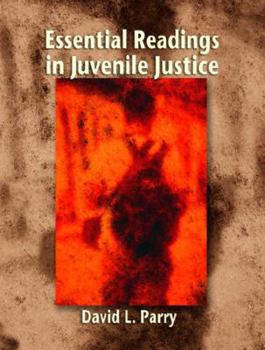
Essential Readings in Juvenile Justice

This one of-a-kind reader brings together concise edited excerpts from more than 50 classic and contemporary articles, cases and other documents that form the essential foundation for understanding... This description may be from another edition of this product.
Format:Paperback
Language:English
ISBN:0130981869
ISBN13:9780130981868
Release Date:March 2004
Publisher:Prentice Hall PTR
Length:432 Pages
Weight:1.47 lbs.
Dimensions:9.1" x 1.0" x 7.0"
Customer Reviews
1 rating
Essential Readings in Juvenile Justice. Edited by David L.
Published by Thriftbooks.com User , 21 years ago
Reviewed by Henry Mendelsohn, Foreign Service Officer, Department of State. As a former Criminal Justice reference librarian and bibliographer I found David L. Parry's new book entitled, Essential Readings in Juvenile Justice, to be of essential value. Before opining further, I need to note that I know Dave Parry, and followed the development of the book through conversations and emails. His recognition of the need for this book and his perseverance in obtaining copyright and reprint permissions was only a warm up for the vast amount of work it took to distill the essence of primary sources drawn from multiple disciplines such as sociology, psychology, and law. As far as I know it is the first text to present core concepts and policy perspectives, key documents, standards, primary court cases and analysis into one comprehensive reader on juvenile justice. Parry has drawn from a wide variety of sources and materials to organize the readings into a cogent examination of the juvenile justice system in the United States. He collated, edited, and abridged primary documents heretofore scattered throughout monographs, journals, legal texts, codes, government publications, and statistical sourcebooks. The overview is presented in ten chapters that trace the basic concepts, processes, and issues, establishment of juvenile courts and initial conceptualization of delinquency, reform movements, policing of juveniles, detention, distinction between adult and juvenile adjudications, corrections, and disparate images of the future of juvenile justice. What I like about Parry's approach is that he has distilled the essence of each document to present it in only a few pages and in some cases a few paragraphs that cover the "essential" points, concepts or arguments, and has arranged each selection in an easy to read manner by using clearly stated paragraph subheadings that outline the chapter. This approach allows teacher, student, researcher and reference librarian to quickly locate basic concepts and definitions, as well as to discern the essence of each selection before delving into the text. Any student who might wish to read further, or identify a topic for a thesis has the basic outline and core documents clearly laid out as a guide for further exploration. A teacher can quickly find a section to expound, or a researcher can find core charts and graphs with references referring to the primary documents. Parry has presented review questions at the end of each selection that can be used for classroom discussion, study aids or suggestions for further research and paper topics. Although Parry intended the book to be used by domestic audiences it also holds great value for overseas audiences interested in learning more about the US model of juvenile justice. I have spent the last ten years working as a foreign service officer specializing in teaching locally hired US embassy staff to use American resources, web sites and databases to present U
Copyright © 2026 Thriftbooks.com
Terms of Use | Privacy Policy | Do Not Sell/Share My Personal Information | Cookie Policy | Cookie Preferences | Accessibility Statement
ThriftBooks ® and the ThriftBooks ® logo are registered trademarks of Thrift Books Global, LLC
ThriftBooks ® and the ThriftBooks ® logo are registered trademarks of Thrift Books Global, LLC
