
Skip to content
Scan a barcode
Scan
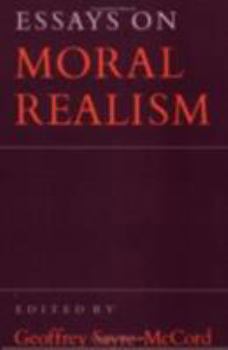
Paperback Essays on Moral Realism Book

ISBN: 0801495415

ISBN13: 9780801495410

Essays on Moral Realism

Select Format

Select Condition ThriftBooks Help Icon

Recommended

Format: Paperback

Condition: Very Good

$6.89
Save $34.06!
List Price $40.95
Almost Gone, Only 2 Left!
Save to List

Book Overview

For the greater part of this century, most philosophers and social scientists have eschewed moral realism. According to their view, moral facts cannot be accommodated by a suitably scientific picture of the world. However, recent developments in moral theory, the philosophy of science, and the philosophy of language have undermined the standard arguments against moral realism and have led many to maintain that there are powerful reasons for believing in moral facts. As a result, moral realism is enjoying renewed vitality, while the arguments against it have of necessity become more sophisticated and penetrating.

This collection of influential essays illustrates the range, depth, and importance of moral realism, the fundamental issues it raises, and the problems it faces. Geoffrey Sayre-McCord has chosen accessible, rigorous, and thought-provoking papers, all of which are rich enough to encourage and reward several readings and careful study. In addition, the volume strikes a balance between wide-ranging papers that advance a barrage of arguments, and more focused papers that develop a few arguments in great detail. What emerges is a comprehensive overview of the moral realism debate that exhibits the scope, as well as the intricacies, of the arguments marshaled on all sides. It will be welcomed by scholars and students of philosophy, the social sciences, and political science.

CONTRIBUTORS: A. J. Ayer, Simon Blackburn, Richard Boyd, Gilbert
Harman, Jonathan Lear, ' J. L. Mackie, John McDowell, Mark Platts,
Geoffrey Sayre-McCord, Nicholas Sturgeon, David Wiggins, Bernard
Williams.

Customer Reviews

2 ratings

Excellent Anthology Covering the Realism/Anti-Realism Debate

To the best of my knowledge, this is the best single volume on the realism/anti-realism dispute in contemporary meta-ethics. What is the realism/anti-realism dispute? Sayre-McCord begins his volume with a twenty-page introduction that answers this question much better than I can in a few hundred words, but here's what I take to be at issue in the dispute. Basically, what is at issue between realists and anti-realists is the objectivity of ethics. According to Sayre-McCord, the central issue is the existence of moral facts. Realists claim that such facts exist; anti-realists deny their existence. There is more to the debate than this, however. The following is a list of claims that most realists will make about morality: (i) there are moral facts (or moral truths), and these facts (or truths) are mind-independent in some important way; (ii) cognitivism about moral discourse is true: that is, moral moral claims purport to describe moral facts (or moral truths), and (at least some of) these claims successfully do so; and (iii) moral knowledge is possible, and we have some of it. Importantly, though, anti-realists needn't deny all three of this claims. In fact, there is an important divide in anti-realism between those anti-realists who are cognitivists and those who are noncognitivists. Anti-realist cognitivists argue that moral discourse purports to describe moral facts, but that there are no such facts. If there are no moral facts and cognitivism is true, then moral practice and discourse appears to involve a pervasive error, an error of attempting to talk about something that doesn't exist. Anti-realist noncognitivists, it seems, needn't accurse ordinary moral discourse and practice of any error. Indeed, if cognitivism is false, then it is realists (and cognitivists more generally) who are guilty of an error. Their error is one of having misunderstood the nature of moral discourse. Moral claims don't even purport to describe reality; instead, they serve some other purpose, like expressing our attitudes, influencing the behavior of others, or prescribing certain types of action. After his introduction, Sayre-McCord divides the anthology into two sections, each of which includes six papers. The section on anti-realism begins with a classic defense of the doctrine from A. J. Ayer's Language, Truth, and Logic. Ayer argues that moral realism conflicts with the tenets of his logical positivism and sketches a rather crude noncognitivist account of moral language. Despite its age, this paper is important as a source of some important anti-realist arguments. It's an early example of noncognitivists taking over Moore's Open Question Argument but rejecting his realist non-naturalist intuitionism as obscure and implausible. It's also an early example of anti-realists appealing to ethical disagreement and the difficulty of reaching moral consensus as evidence for their views. This section of the anthology includes several interesting

Review of Essays on Moral Realism

In Essays on Moral Realism, Geoffrey Sayre-McCord has compiled almost all influential modern essays on the topic. Entries include arguments for both realism and anti-realism and explore a variety of outlooks including the error theory, cognitivism, noncognitivism, subjectivism, and others. Sayre-McCord provides a very helpful introduction describing the main points of these views and how they relate to each other. In order to gain a complete understanding of the arguments going on in the field of moral realism, Sayre-McCord's book is a must read.
Copyright © 2026 Thriftbooks.com Terms of Use | Privacy Policy | Do Not Sell/Share My Personal Information | Cookie Policy | Cookie Preferences | Accessibility Statement
ThriftBooks® and the ThriftBooks® logo are registered trademarks of Thrift Books Global, LLC

GoDaddy Verified and Secured