


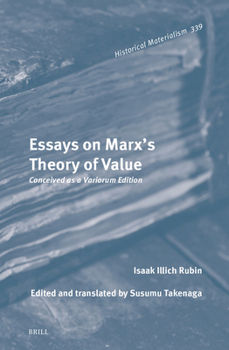
Essays on Marx's Theory of Value: Conceived as a Variorum Edition
(Book #53 in the Cuadernos de Pasado y Presente Series)

Select Format
Select Condition 
Book Overview
This book is an English translation of Essays on Marx's Theory of Value, first published by Isaak Illich Rubin in 1923 in the Soviet Union. Rubin's book sparked a fierce value controversy with contemporary Soviet economists during the late 1920s. As such, the present translation is conceived as a variorum edition, including for the first time in English all the essential supplementary materials related to this foundational work in Marx's value theory. In addition to Rubin's main work, this edition includes his four most important related publications, as well as ten debate articles written and published by his contemporary proponents and opponents.
Format:Hardcover
Language:English
ISBN:9004721339
ISBN13:9789004721333
Release Date:February 2025
Publisher:Brill
Length:992 Pages
Weight:3.45 lbs.
Dimensions:1.4" x 6.5" x 2.9"
Customer Reviews
2 ratings
High-point of Marxist political economy
Published by Thriftbooks.com User , 21 years ago
Rubin was an economic historian and Bolshevik murdered by the Soviet state in the late 1920's during the Stalinist purges.The terminology is old-fashioned but the ideas are surprising and original. Unlike most interpreters of Marx, Rubin actually extends and clarifies Marx's theory of economic value. He explains how Marx's theory of value is essentially concerned with how markets allocate the total available labour of a society to different productive activities. Rubin examines the dynamic, causal relationship between labour time and monetized market exchanges. This is a very different point of view compared to most post-war interpretations of Marx's economic theory. Rubin's book is required reading for anyone who seriously wants to understand Marx's theory of value, and is an undisputed classic of Marxist political economy.
Fredy Perlman and Rubin Illuminate Marx
Published by Thriftbooks.com User , 24 years ago
This is the best of the many interpretations of Marx's political economy. It may not be for beginners, who might want to take a look at Perlman's "Reproduction of Everyday Life," Ollman's "What is Marxism," and "Alienation," and, perhaps, Rius' "Marx for Beginners." Even Fischer's "How to Read Karl Marx," is an easier start. Marty Glaberman's work is exemplary in many was as well. But sooner or later the serious critic is going to need to encounter the incredible insights of these two. Perlman and Rubin truly grasp the interaction of commodity fetishism and the social relations capital produces--as a source of enlightened hope. Perlman, who died in his early fifties in Detroit, led a life that was guided by the thought his comrade-wife, Loraine, captured in the title of her book about him, "Having little, being much." Perlman hand-made his earlier books on his own press--with a small collective of people. I think he was trying to demonstrate the possible unity of aesthetics, love, community, work, and the struggle for the truth. The introduction of "Essays" alone is worth the candle. Perlman's "Continuing Appeal of Nationalism," done on the Black and Red Press, is an interesting counterpoint, as is the huge "Against Leviathan."
Copyright © 2026 Thriftbooks.com Terms of Use
| Privacy Policy | Do Not
Sell/Share My Personal Information | Cookie Policy | Cookie Preferences | Accessibility Statement
ThriftBooks® and the ThriftBooks® logo are registered trademarks of Thrift Books Global, LLC
ThriftBooks® and the ThriftBooks® logo are registered trademarks of Thrift Books Global, LLC
