


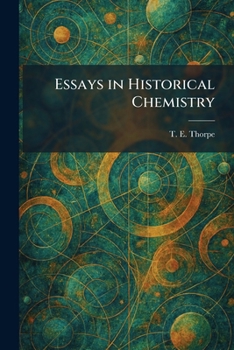
Essays in Historical Chemistry

Select Format
Select Condition 
Book Overview
"Essays in Historical Chemistry" is a distinguished collection of biographical and thematic studies exploring the evolution of chemical science. Written by the renowned chemist T. E. Thorpe, this work provides a comprehensive look at the lives and discoveries of the pioneering figures who shaped the foundations of modern chemistry. Through a series of engaging essays, the author traces the development of critical theories and the experimental breakthroughs of luminaries such as Robert Boyle, Joseph Priestley, Antoine Lavoisier, and John Dalton.
Thorpe's writing balances scientific rigor with accessible historical narrative, making the complex history of chemical discovery available to both students and enthusiasts of the history of science. The book examines the intellectual environment of different eras, illustrating how individual genius and collaborative effort combined to unlock the secrets of matter and its transformations. By focusing on the human element behind the laboratory equipment, "Essays in Historical Chemistry" illuminates the challenges, controversies, and triumphs that have defined the discipline. This work remains a vital resource for understanding the historical context of scientific progress and the enduring legacy of those who first mapped the chemical world.
This work has been selected by scholars as being culturally important, and is part of the knowledge base of civilization as we know it. This work was reproduced from the original artifact, and remains as true to the original work as possible. Therefore, you may see the original copyright references, library stamps (as most of these works have been housed in our most important libraries around the world), and other notations in the work.
This work is in the public domain in the United States of America, and possibly other nations. Within the United States, you may freely copy and distribute this work, as no entity (individual or corporate) has a copyright on the body of the work.
As a reproduction of a historical artifact, this work may contain missing or blurred pages, poor pictures, errant marks, etc. Scholars believe, and we concur, that this work is important enough to be preserved, reproduced, and made generally available to the public. We appreciate your support of the preservation process, and thank you for being an important part of keeping this knowledge alive and relevant.
Customer Reviews
ThriftBooks ® and the ThriftBooks ® logo are registered trademarks of Thrift Books Global, LLC
