
Skip to content
Scan a barcode
Scan
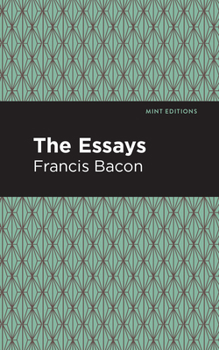
Hardcover The Essays: Francis Bacon Book

ISBN: 1513220039

ISBN13: 9781513220031

The Essays: Francis Bacon

Select Format

Select Condition ThriftBooks Help Icon

Recommended

Format: Hardcover

Condition: New

$12.66
Save $1.33!
List Price $13.99
Ships within 2-3 days
Save to List

Book Overview

The Essays (1625) is a collection of writings by Francis Bacon, one of England's most prominent philosophers and scientists whose work was central to shaping the ideals of the Renaissance and scientific revolution. Although Bacon is remembered today as the father of modern science, this collection contains his thoughts on mostly moral and civil matters, highlighting his immense skill as a philosopher and statesman.

Filled with references to and quotes from such biblical and classical sources as Seneca, Epicurus, Solomon, David, and Caesar-to name only a few-Bacon grounds his work in the rich continuum of human history, religion, and philosophy. In "Of Death," he compares the human fear of death to a child's fear of the dark to argue that it is an essential and natural aspect of human life. In "Of Revenge," Bacon weighs the consequences of vindictiveness against the merciful necessity of forgiveness. In "Of Goodness and Goodness of Nature," Bacon differentiates between the innate goodness of humanity and the glaring need for the cultivation of goodness as a habit in human society. These are only some of the subjects Bacon approaches with his hallmark rational and concise style. Others include the relationship between parents and children, the nature of superstition, and the need to privilege utility over style in homebuilding. Overall, The Essays is both a wide-ranging meditation on daily and eternal matters of human existence and a fascinating look at the particulars of life in Renaissance England.

Completed only a year before his death, The Essays is one of Francis Bacon's most accessible works, as well as a fitting culmination of a life and career dedicated to the pursuit of knowledge. This text illuminates for us the thoughts and feelings of one of history's finest intellectuals, a man whose ideas continue to shape our world and the way we see it over four centuries later.

This edition of The Essays by Francis Bacon is a classic of English literature and philosophy reimagined for modern readers.

Since our inception in 2020, Mint Editions has kept sustainability and innovation at the forefront of our mission. Each and every Mint Edition title gets a fresh, professionally typeset manuscript and a dazzling new cover, all while maintaining the integrity of the original book.

With thousands of titles in our collection, we aim to spotlight diverse public domain works to help them find modern audiences. Mint Editions celebrates a breadth of literary works, curated from both canonical and overlooked classics from writers around the globe.

Customer Reviews

5 ratings

Academic yet Enriching!

Bold statements are made in these essays - essentially changing the way man thought about his universe. A great study in scientific thought and materialism.

Recommended reading, but footnotes excessive in this edition

Francis Bacon was an observant and insightful student of human society and human nature, as reflected in most of the essays here. The perspective *is* a bit bourgeois, but I guess Bacon can't help having been a nobleman. A lot of the later essays in the book seem to be along the lines of "how to put people to good use." Included also in this volume is a quite detailed biographical sketch at the beginning, and some extra material with aphoristic sketch-like versions of a few of the essays, plus the "Antitheses of Things," which is quite interesting.The language is essentially Shakespearean, which I always enjoy reading, as it gives one the sense of watching as phrases and words are coined before your eyes (Shakespeare coined INNUMERABLE words and phrases in his works, and Bacon does a few here too, actually, according to the Explanatory Notes); a refreshing change from modern language, where we basically speak in cliches. The problem is, this edition (Oxford's World's Classics) has SO MANY "translational" footnotes explaining his 17th-century word usage, that it's quite distracting and unnecessary. One has to learn to basically ignore them most of the time. The Explanatory Notes collected at the end are quite indispensable for dealing with Bacon's penchant for endless streams of Latin quotes and likely-obscure-to-the-modern-reader classical references, but the footnotes are just ridiculous. I'd guess one could reasonably assume that anyone who'd pick up this book in the first place would not need to be told that "contrariwise" means "on the contrary," "mark" means "observe," "magnanimity" means "noble, generous feelings," "overlaid" means "burdened"... I could go on and on. I don't know if other editions have as thorough Explanatory Notes as this, though; if they do I'd go with that over this edition.

Essential

There are few writers I have read in my entire life who have taught me more than Francis Bacon. These essays are simply essential.

The Renaissance Socrates

It's useless to dig for just one or two epigrams to stand in for the totality of Bacon's penetrating genius in the "Essays." Though it is perhaps fashionable today to detract from him in order to praise Montaigne, it should be clear that Bacon is at least as indispensable. As terse as Emerson is expansive, Bacon's "Essays" are perhaps the most truly Classical (in spirit) prose in the English language. Fans of the Leo Strauss school should have a fieldday reading between the lines of the essays "On Atheism" and "On Superstition"; for the rest of us, nobody can come away from even one of these essays without gaining invaluable insights. Though Bacon is rightly heralded for the radical newness of his pragmatic methods, he is ensteeped in history-- those mindful of Napoleon's dictum that history is the only true philosophy will certainly respond enthusiastically to Bacon's approach. From the post-Machiavellian insights of "Of Empire" to the pre-Enlightenment ethics of "Of Goodness and Goodness of Nature", one will find in reading Bacon's prose what the youth of Athens must have found in following Socrates: the presence of a benevolent, worldly-wise, supremely rational mind determined to show you the order of the world.

a timeless classic

Along with Shakespeare's works, Bacon's "Essays" is the supreme achievement of the English Renaissance. Philosopher, statesman, author, Bacon made all knowledge his province, and in the "Essays" is to be found more worldly wisdom than in any other book. "My essays come home, to men's business and bosoms." And Pope penned the epitaph, "If parts allure thee think how Bacon shined, The wisest, brightest, meanest of mankind." These essays, though, need a gloss for the modern reader to understand Bacon's cramped yet erudite prose and Latin quotations, as is provided in Pitcher's edition.
Copyright © 2026 Thriftbooks.com Terms of Use | Privacy Policy | Do Not Sell/Share My Personal Information | Cookie Policy | Cookie Preferences | Accessibility Statement
ThriftBooks® and the ThriftBooks® logo are registered trademarks of Thrift Books Global, LLC

GoDaddy Verified and Secured