


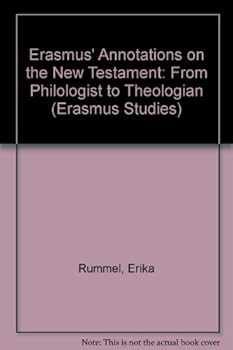
Erasmus' Annotations on the New Testament (Erasmus Studies)
No Customer Reviews

Without the notes, Erasmus said, the texts of the Scripture were 'naked and defenceless, ' open to criticism by uncomprehending readers and corruption by careless printers. The "Annotations" represent not only Erasmus' defence of the New Testament against such abuss, but also a reflection of his own philosophy, objectives, and working methods.In establishing the text and defending it against his opponents, Erasmus drew on manuscript sources, classical literature, patristic writings, scholastic exegesis, and the work of his immediate forerunners, Valla and Lefevre. He did not hesitate to point out the errors of illustrious writers like Jerome and established medieval authorities like Peter Lombard. In general he was appreciative of the early church Fathers and contemptuous of medieval commentators.As well as discussing the contents and aims of the "Annotations," Erika Rummel investigates Erasmus' development from philologist to theologian and traces the prepublication history of the New Testament. She examines the critical reaction of conservative theologians to Erasmus' work and his replies, incorporated in later editions of the "Annotations." The book ends by suggesting a wider field of research: the relationship between the "Annotations" and the corpus of Erasmian apologetic works.
Format:Hardcover
Language:English
ISBN:0802056830
ISBN13:9780802056832
Release Date:November 1986
Publisher:University of Toronto Press, Scholarly Publishing Division
Length:234 Pages
Weight:1.10 lbs.
Dimensions:9.3" x 0.9" x 5.9"
Customer Reviews
0 rating
Copyright © 2026 Thriftbooks.com Terms of Use
| Privacy Policy | Do Not
Sell/Share My Personal Information | Cookie Policy | Cookie Preferences | Accessibility Statement
ThriftBooks® and the ThriftBooks® logo are registered trademarks of Thrift Books Global, LLC
ThriftBooks® and the ThriftBooks® logo are registered trademarks of Thrift Books Global, LLC
