


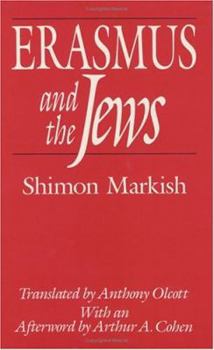
Erasmus and the Jews
No Customer Reviews

Select Format
Select Condition 
Book Overview
Erasmus of Rotterdam was the greatest Christian humanist scholar of the Northern European Renaissance, a correspondent of Sir Thomas More and many other learned men of his time, known to his contemporaries and to posterity for subtlety of his thought and the depth of his learning. He was also, according to some modern writers, an anti-Semite. In this complete analysis of all of Erasmus' writings on Jews and Judaism, Shimon Markish asserts that the accusation cannot be sustained. For Markish, to ask whether Erasmus was a friend or enemy of the Jews is to ask a modern question of a sixteenth-century man, whose attitude can best be called "asemitism." Erasmus' chief preoccupation was with the future of "the true philosophy of Christ"; he had little interest in the Jewish community of his own time. Erasmus and the Jews discusses Erasmus' critique of Mosaic law and his view of the conflict between "Judaism" as legalistic morality and Jesus' teaching; his judgment on the Pharisees of Jesus' time; his emphasis on the importance of the study of Hebrew; and his opinions of sixteenth-century Jews. This meticulous analysis reveals an Erasmus who defended his vision of true piety by rejecting "Judaizing" Christians more than Jews and who saw the Old Testament as integral to the Christian worldview. As a Christian, he regretted nonbelief and pitied unbelievers, without vicious hostility toward any single people. His theological opposition to a form of religious thought which he identified with Judaism was not translated into crude prejudice against actual Jews. In general, his calm consideration of the strange and the foreign and his willingness to restrict his judgments to the philosophical realm were, Markish argues, early and significant steps toward enlightened toleration. Markish's discussion of Erasmus is supplemented with an Afterword by theologian and philosopher Arthur A. Cohen, who offers a variant interpretation of Erasmus' writings and attitudes. The juxtaposed arguments of the two scholars make this an especially illuminating work for any student of Erasmus and his influence. Erasmus and the Jews also gives a necessary clarity to our understanding of the meaning of anti-Semitism and the history of religious toleration. Markish's profound knowledge of Erasmus allows him to demonstrate the fundamental importance of putting arguments and terminology in the context of a thinker's work and his own time.
Format:Hardcover
Language:English
ISBN:0226505901
ISBN13:9780226505909
Release Date:February 1986
Publisher:University of Chicago Press
Length:212 Pages
Weight:0.90 lbs.
Dimensions:0.7" x 5.8" x 8.8"
Customer Reviews
0 rating
Copyright © 2026 Thriftbooks.com
Terms of Use | Privacy Policy | Do Not Sell/Share My Personal Information | Cookie Policy | Cookie Preferences | Accessibility Statement
ThriftBooks ® and the ThriftBooks ® logo are registered trademarks of Thrift Books Global, LLC
ThriftBooks ® and the ThriftBooks ® logo are registered trademarks of Thrift Books Global, LLC
