


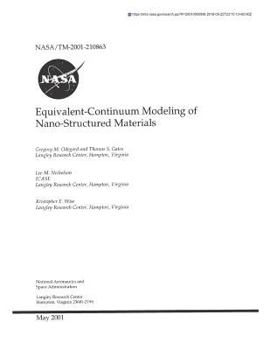
Equivalent-Continuum Modeling of Nano-Structured Materials
No Customer Reviews

A method has been developed for modeling structure-property relationships of nano-structured materials. This method serves as a link between computational chemistry and solid mechanics by substituting discrete molecular structures with an equivalent-continuum model. It has been shown that this substitution may be accomplished by equating the vibrational potential energy of a nano-structured material with the strain energy of representative truss and continuum models. As an important example with direct application to the development and characterization of single-walled carbon nanotubes, the model has been applied to determine the effective continuum geometry of a graphene sheet. A representative volume element of the equivalent-continuum model has been developed with an effective thickness. This effective thickness has been shown to be similar to, but slightly smaller than, the interatomic spacing of graphite.Odegard, Gregory M. and Gates, Thomas S. and Nicholson, Lee M. and Wise, Kristopher E.Langley Research CenterCONTINUUM MODELING; COMPUTATIONAL CHEMISTRY; SOLID MECHANICS; MOLECULAR STRUCTURE; NANOTUBES; FINITE ELEMENT METHOD; NANOTECHNOLOGY; THICKNESS; POTENTIAL ENERGY
Format:Paperback
Language:English
ISBN:1723723568
ISBN13:9781723723568
Release Date:January 1
Publisher:Independently Published
Length:36 Pages
Weight:0.24 lbs.
Dimensions:0.1" x 8.5" x 11.0"
Customer Reviews
0 rating
Copyright © 2025 Thriftbooks.com
Terms of Use | Privacy Policy | Do Not Sell/Share My Personal Information | Cookie Policy | Cookie Preferences | Accessibility Statement
ThriftBooks ® and the ThriftBooks ® logo are registered trademarks of Thrift Books Global, LLC
ThriftBooks ® and the ThriftBooks ® logo are registered trademarks of Thrift Books Global, LLC
