


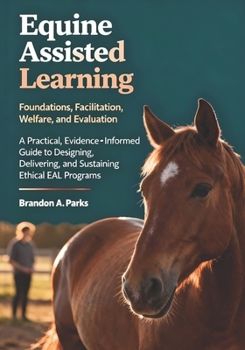
Equine Assisted Learning: Foundations, Facilitation, Welfare, and Evaluation A Practical, Evidence-Informed Guide to Designing, Delivering, and Sustai

Design equine-assisted learning programs that put horse welfare first and deliver real-world results. Equine Assisted Learning sits at the intersection of education, psychology, human-animal interaction, and equine science. This comprehensive guide turns ethics and evidence into practical tools you can use immediately-whether you work in schools, community programs, leadership development, or organizational learning.
What you'll learn
Clear scope and language: Define EAL-and distinguish it from equine-assisted therapy, hippotherapy, and therapeutic riding-so your practice and marketing stay accurate and ethical.
Experiential design that works: Apply Kolb, Dewey, and Sch n to build short cycles of engage-debrief-iterate for stickier learning.
Motivation and nervous system literacy: Use Self-Determination Theory (autonomy, competence, relatedness) and polyvagal-informed, trauma-informed facilitation for safe, effective sessions.
Equine behavior and welfare: Read equine signals, apply the Five Domains and the "3Fs" (forage, friends, freedom), and train within LIMA (Least Intrusive, Minimally Aversive).
Facilitation micro-skills: Observation language, ORID debriefing, clean questions, and transfer planning so insights travel beyond the arena.
Populations and adaptations: Youth SEL, adult teams, veterans/first responders, neurodiversity, accessibility, and culturally responsive practices.
Practical activities and curricula: Ready-to-use activity cards, session templates, multi-week progressions, and transfer strategies.
Risk, safety, and legal basics: Layered controls (ALARP, hierarchy of controls), emergency drills, biosecurity, safeguarding, and documentation.
Measurement and research: Build logic models, choose valid measures, and run mixed-methods evaluation for continuous improvement.
Implementation and sustainability: Staffing, budgets, partnerships, grant readiness, standards alignment, land stewardship, and climate resilience.
Who it's for
Educators and facilitators designing EAL sessions and curricula
Equine professionals and specialists stewarding horse welfare and safety
Program directors and administrators building sustainable operations
Students, researchers, and partners seeking shared language and rigor
Leaders and coaches integrating experiential learning with horses
Why this book
Welfare-first: Horses are co-facilitators with agency and choice.
Evidence-informed: Practical synthesis of experiential education, behavioral science, and equine ethology.
Field-tested tools: Templates, checklists, rubrics, and case vignettes to put into practice right away.
Customer Reviews
ThriftBooks® and the ThriftBooks® logo are registered trademarks of Thrift Books Global, LLC
