


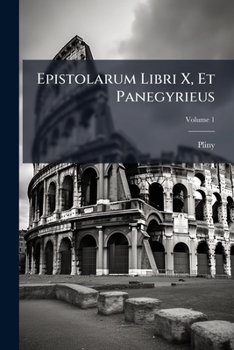
Epistolarum Libri X, Et Panegyrieus: Ex Recensione J.m. Gesneri; Volume 1

This is Volume 1 of "Epistolarum Libri X, Et Panegyrieus," presenting the letters of Pliny the Younger, meticulously reviewed by J.M. Gesner. Pliny's letters offer invaluable insights into the social, political, and cultural life of the Roman Empire during the late first and early second centuries CE. A contemporary of Tacitus and Trajan, Pliny's correspondence touches on a wide range of topics, from daily life in Rome to governance and imperial administration.
These letters are crucial for understanding Roman history, offering perspectives on everything from the eruption of Vesuvius to the lives of prominent Roman citizens. This edition allows readers to engage directly with primary source material, providing a window into the world of one of Rome's most eloquent and influential figures. The collection includes the 'Panegyricus, ' Pliny's oration praising Emperor Trajan, a key text for understanding Roman imperial ideology.
This work has been selected by scholars as being culturally important, and is part of the knowledge base of civilization as we know it. This work was reproduced from the original artifact, and remains as true to the original work as possible. Therefore, you will see the original copyright references, library stamps (as most of these works have been housed in our most important libraries around the world), and other notations in the work.
This work is in the public domain in the United States of America, and possibly other nations. Within the United States, you may freely copy and distribute this work, as no entity (individual or corporate) has a copyright on the body of the work.
As a reproduction of a historical artifact, this work may contain missing or blurred pages, poor pictures, errant marks, etc. Scholars believe, and we concur, that this work is important enough to be preserved, reproduced, and made generally available to the public. We appreciate your support of the preservation process, and thank you for being an important part of keeping this knowledge alive and relevant.
Related Subjects
HistoryCustomer Reviews
ThriftBooks® and the ThriftBooks® logo are registered trademarks of Thrift Books Global, LLC
