


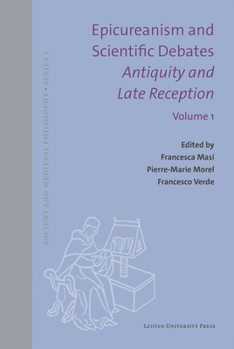
Epicureanism and Scientific Debates. Antiquity and Late Reception: Language, Medicine, Meteorology

Epicureanism is not only a defence of pleasure: it is also a philosophy of science and knowledge. This edited collection explores new pathways for the study of Epicurean scientific thought, a hitherto still understudied domain, and engages systematically and critically with existing theories. It shows that the philosophy of Epicurus and his heirs, from antiquity to the classical age, founded a rigorous and coherent conception of knowledge. This first part of a two-volume set examines more specifically the contribution of Epicureanism in the fields of language, medicine, and meteorology (i.e., celestial, geological and atmospheric phenomena).
Offering a renewed image of Epicureanism, the book includes studies on the nature of human language and on the linguistic aspects of scientific discourse; on the relationship between Epicureanism and ancient medicine, from Hippocrates to Galen; on meteorological phenomena and the method of explaining them; and on the reception of Epicurus's legacy in Gassendi.
Contributors: Julie Giovacchini (CNRS, Paris), Francesca Masi (Universit Ca' Foscari Venezia), Dino De Sanctis (Universit degli Studi della Tuscia), Chiara Rover (Universit t Hamburg/MCAS), Enrico Piergiacomi (Universit t Z rich), David Leith (University of Exeter), Vincenzo Damiani (Universit t Ulm), David Konstan (New York University), Voula Tsouna (UC Santa Barbara), J rgen Hammerstaedt (Universit t zu K ln), Craig Martin (Universit Ca' Foscari Venezia), Frederik Bakker (Radboud Universiteit)
Related Subjects
PhilosophyCustomer Reviews
ThriftBooks ® and the ThriftBooks ® logo are registered trademarks of Thrift Books Global, LLC
