


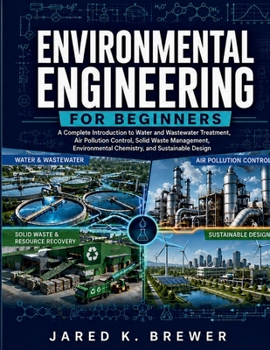
Environmental Engineering for Beginners: A Complete Introduction to Water and Wastewater Treatment, Air Pollution Control, Solid Waste Management, Env

Tired of environmental engineering resources that either skim the surface or bury you in theory you can't actually apply?
You want to understand water treatment, air pollution control, and waste management well enough to run the actual calculations - size a clarifier, model a pollution plume, design a landfill cell - not just recite definitions. Most books make you choose between "easy to read" and "actually useful." This one doesn't.
Environmental Engineering for Beginners is a complete, 18-chapter foundation in the entire discipline - built so you can use it, not just read it.
Inside, you'll work through:
Environmental chemistry & microbiology - stoichiometry, acid-base and buffer chemistry, equilibrium, redox reactions, microbial growth kinetics, and the biology behind every treatment processWater treatment - coagulation, flocculation, sedimentation, and filtration design; disinfection (CT calculations, breakpoint chlorination, UV, ozone); softening; membrane processes and activated carbon adsorptionWastewater treatment - BOD/DO sag curve modeling, sewer hydraulics, activated sludge and trickling filter design, nitrogen and phosphorus removal, and sludge/biosolids managementAir pollution - atmospheric dispersion and Gaussian plume modeling, plus control technologies: cyclones, electrostatic precipitators, baghouses, and scrubbersSolid & hazardous waste - waste characterization, landfill design, leachate and gas management, composting, and contaminated-site remediationRisk, regulation & sustainability - environmental impact assessment, risk-based exposure calculations, life-cycle assessment, and green infrastructure design...and many more.
By the time you finish, you'll be able to:
Size and design the core unit processes in a water or wastewater treatment plantCalculate pollutant dispersion, dissolved oxygen sag curves, and disinfection dosing by handWork through a landfill capacity, leachate, or gas-generation calculation from scratchRead and apply the same governing equations used in professional practice - because every one of them is fully derived, not just handed to youCheck your own work against 100+ fully worked numerical examples and hundreds of practice problems with answer keys, covering every method in the bookThis isn't a light survey - it's a working reference built to be the one book you actually keep on your desk.
Scroll up and get your copy - and start building environmental engineering skill you can actually use.
Customer Reviews
ThriftBooks ® and the ThriftBooks ® logo are registered trademarks of Thrift Books Global, LLC
