


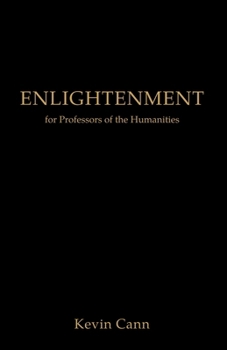
Enlightenment for Professors of the Humanities
No Customer Reviews

Two civilizations spent centuries erasing half a person in order to see clearly. They erased opposite halves and called it enlightenment. The Western Enlightenment went after feeling and intuition. Eastern enlightenment went after the thinking self. This book argues they are the same move, and that both leave a person running on half of what he was issued at birth. Gopi Krishna spent forty-seven years asking to be studied. He mailed a thousand books to scholars and scientists, had a laboratory and a standing invitation, and was investigated by nobody. His last words to his friends were "Don't be superstitious." Graham Wallas wrote down the method in 1926 and went out of print. Fifty years of flow research measured a wordless state and never asked whether it delivers an answer a man did not already have. This book is about the people who reached the seam between the two channels and what it cost them. The division was never geographic. Shankara argued epistemology through thousands of pages, the Nyāya logicians spent centuries in pure reason, and Europe ran a wordless practice of its own the whole time under a long succession of names. What differs is the settlement each school made between the verbal mind and the wordless one. The book sorts what the Eastern systems actually claim, one at a time, and shows that the category "enlightenment" was manufactured in nineteenth-century English and aimed at traditions that never asked for it. It recovers gnosis, the word Plato coined for direct knowing four centuries before any religion used it. And it follows the Western antibody: the demand for public evidence that broke the Church's monopoly on transcendence, ran through Descartes and his misreading, hardened in logical positivism, and ended by ruling the wordless channel inadmissible. D. T. Suzuki, Gananath Obeyesekere, Anya Foxen, David McMahan and April DeConick are read closely along the way. Every finding is entered on a ledger as a candidate, named as testimony, self-selected and unblinded, and denied a verdict the evidence cannot support. The recurrence across cultures is credited to shared anatomy rather than to any lineage. No golden thread, no perennial wisdom, nothing to take on faith. The book ends by asking for something. Ten open research jobs are named in the first pages, across religious studies, intellectual history, philosophy, literary studies, anthropology, cognitive psychology and clinical medicine, and a later chapter sets out what each field already holds. The author offers one candidate practice of his own, four exercises with no lineage and no cosmology attached, the first of them thirty seconds a day, and puts it on the same ledger as everything else. Kevin Cann is not a professor. He was a nuclear machinist mate in the Navy, responsible for two reactors and eighty men. He teaches at the Esalen Institute, and a geophysics journal published his work this year. He has wanted to be part of a project like this since he was twelve. He is sixty-five. "I try like the dickens. Check me."
Format:Paperback
Language:English
ISBN:1971853453
ISBN13:9781971853451
Release Date:July 2026
Publisher:Platonic Surrealism Press
Length:374 Pages
Weight:0.95 lbs.
Dimensions:0.8" x 5.5" x 8.5"
Customer Reviews
0 rating
Copyright © 2026 Thriftbooks.com
Terms of Use | Privacy Policy | Do Not Sell/Share My Personal Information | Cookie Policy | Cookie Preferences | Accessibility Statement
ThriftBooks ® and the ThriftBooks ® logo are registered trademarks of Thrift Books Global, LLC
ThriftBooks ® and the ThriftBooks ® logo are registered trademarks of Thrift Books Global, LLC
