


All Formats & Editions
Collected Works of Ralph Waldo Emerson
Emerson traveled broadly in England and Scotland in 1833 and again on lecture tour fifteen years later. Drawing on his experiences there as well as his wide reading in British history, he set forth in English Traits his view of the English as a nation. Published in...
English Traits
English Traits "I have been twice in England. In 1833, on my return from a short tour in Sicily, Italy, and France, I crossed from Boulogne, and landed in London at the Tower stairs. It was a dark Sunday morning; there were few people in the streets; and I remember the pleasure...
English Traits
English Traits is based around two influential visits to England (in 1833 and in 1847) where Emerson met with literary icons such as Coleridge, Carlyle, and Wordsworth, he began to recognize the source of everything American -- from the laws of society to the plot of a novel...

English Traits
A brisk, lucid invitation to a world beyond the bustling modern mind. Emerson's English Traits surveys the moral weather of Victorian England with clarity, wit, and a humane curiosity that still resonates. This ambitious essay collection blends english character analysis with...

The Complete Works Of Ralph Waldo Emerson: Engl...
This work has been selected by scholars as being culturally important, and is part of the knowledge base of civilization as we know it. This work was reproduced from the original artifact, and remains as true to the original work as possible. Therefore, you will see the original...
English Traits
During two influential visits to England (in 1833 and in 1847) where he met with literary icons such as Coleridge, Carlyle, and Wordsworth, Ralph Waldo Emerson recognized the source of everything American -- from the laws of society to the plot of a novel. Though he admired England's...

English Traits - Ralph Waldo Emerson Vol V Hard...
Emerson's Complete Works: English Traits
This work has been selected by scholars as being culturally important, and is part of the knowledge base of civilization as we know it. This work was reproduced from the original artifact, and remains as true to the original work as possible. Therefore, you will see the original...

English Traits
Reprint of the original, first published in 1872.

English Traits
Reprint of the original, first published in 1872.
Emerson's Complete Works: English Traits
English Traits.By: Ralph Waldo Emerson
Ralph Waldo Emerson (May 25, 1803 - April 27, 1882), known professionally as Waldo Emerson, was an American essayist, lecturer, and poet who led the Transcendentalist movement of the mid-19th century. He was seen as a champion of individualism and a prescient critic of the countervailing...
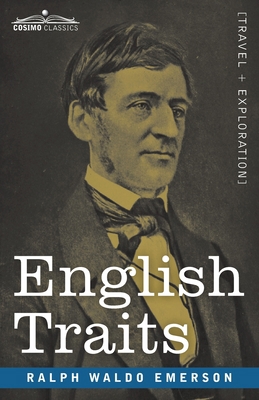
English Traits
"The book has no equal in its kind. It is the wittiest work of America's wittiest writer." -Mark van Doren, American Pulitzer Prize-winning poet, writer, and critic In English Traits (1856), Ralph Waldo Emerson blends his observations of the English...

English Traits: annotated

English Traits
Reprint of the original, first published in 1857.

English Traits
Reprint of the original, first published in 1857.
English Traits
Ralph Waldo Emerson's "English Traits" offers a fascinating exploration of 19th-century English society and culture. Through keen observation and insightful analysis, Emerson examines the essence of the English national character, delving into the societal norms, customs,...
English Traits
Ralph Waldo Emerson's "English Traits" offers a fascinating exploration of 19th-century English society and culture. Through keen observation and insightful analysis, Emerson examines the essence of the English national character, delving into the societal norms, customs,...
English Traits
English Traits is a non-fiction book written by the renowned American philosopher and essayist Ralph Waldo Emerson. The book is a collection of Emerson's observations and reflections on the English people and their culture, based on his travels to England in the mid-19th century...
English Traits
This is a reproduction of a book published before 1923. This book may have occasional imperfections
such as missing or blurred pages, poor pictures, errant marks, etc. that were either part of the original artifact,
or were introduced by the scanning process. We believe...
English Traits
This is a reproduction of a book published before 1923. This book may have occasional imperfections such as missing or blurred pages, poor pictures, errant marks, etc. that were either part of the original artifact, or were introduced by the scanning process. We believe this...
ThriftBooks® and the ThriftBooks® logo are registered trademarks of Thrift Books Global, LLC
