


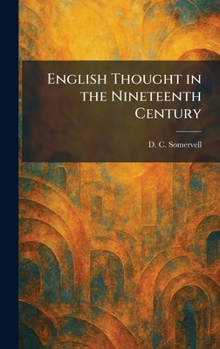
English Thought in the Nineteenth Century

"English Thought in the Nineteenth Century" offers a comprehensive survey of the intellectual landscape during one of Britain's most transformative eras. D. C. Somervell masterfully traces the evolution of ideas from the aftermath of the French Revolution to the dawn of the twentieth century, examining the complex interplay between politics, religion, and social change. The work delves into the rise of Utilitarianism, the influence of the Romantic movement, and the profound impact of scientific advancements, particularly the Darwinian revolution, on traditional belief systems.
Somervell explores the contributions of key figures such as Bentham, Mill, Newman, and Arnold, contextualizing their theories within the broader socio-political struggles of the time. By highlighting the shift from individualism to collectivism and the growing debates surrounding democracy and social reform, the book provides an essential guide to the currents that shaped modern British society. This intellectual history is indispensable for readers seeking to understand the foundations of Victorian culture and the persistent philosophical questions that defined the age. With its clear analysis and broad scope, "English Thought in the Nineteenth Century" remains a vital resource for students of history, philosophy, and political science.
This work has been selected by scholars as being culturally important, and is part of the knowledge base of civilization as we know it. This work was reproduced from the original artifact, and remains as true to the original work as possible. Therefore, you may see the original copyright references, library stamps (as most of these works have been housed in our most important libraries around the world), and other notations in the work.
This work is in the public domain in the United States of America, and possibly other nations. Within the United States, you may freely copy and distribute this work, as no entity (individual or corporate) has a copyright on the body of the work.
As a reproduction of a historical artifact, this work may contain missing or blurred pages, poor pictures, errant marks, etc. Scholars believe, and we concur, that this work is important enough to be preserved, reproduced, and made generally available to the public. We appreciate your support of the preservation process, and thank you for being an important part of keeping this knowledge alive and relevant.
Customer Reviews
ThriftBooks ® and the ThriftBooks ® logo are registered trademarks of Thrift Books Global, LLC
