


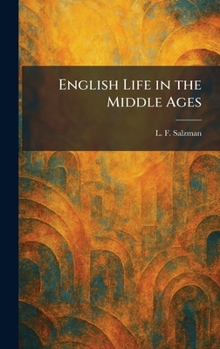
English Life in the Middle Ages

"English Life in the Middle Ages" offers a comprehensive and engaging exploration of the daily existence of various social classes in medieval England. This work provides a vivid tapestry of the period, covering the intricacies of the feudal system, the lives of the peasantry, the rise of the merchant class, and the pervasive influence of the Church. Readers are introduced to the realities of both town and country, exploring essential themes such as education, trade, law, and warfare.
Through meticulous detail, the text illustrates how people lived, worked, and spent their leisure time, making the complex social structures of the Middle Ages accessible and fascinating. This book serves as an essential resource for those interested in the social history of Britain, providing a detailed look at the customs, clothing, and domestic lives that shaped the foundation of English society. With its focus on the human element of history, "English Life in the Middle Ages" remains a valuable contribution to the study of medieval civilization, capturing the spirit of an era through its social and cultural developments.
This work has been selected by scholars as being culturally important, and is part of the knowledge base of civilization as we know it. This work was reproduced from the original artifact, and remains as true to the original work as possible. Therefore, you may see the original copyright references, library stamps (as most of these works have been housed in our most important libraries around the world), and other notations in the work.
This work is in the public domain in the United States of America, and possibly other nations. Within the United States, you may freely copy and distribute this work, as no entity (individual or corporate) has a copyright on the body of the work.
As a reproduction of a historical artifact, this work may contain missing or blurred pages, poor pictures, errant marks, etc. Scholars believe, and we concur, that this work is important enough to be preserved, reproduced, and made generally available to the public. We appreciate your support of the preservation process, and thank you for being an important part of keeping this knowledge alive and relevant.
Customer Reviews
ThriftBooks ® and the ThriftBooks ® logo are registered trademarks of Thrift Books Global, LLC
