


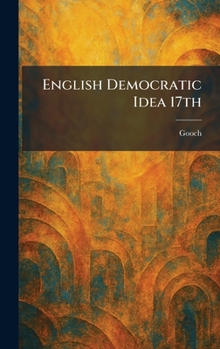
English Democratic Idea 17th

"English Democratic Idea 17th" is a seminal examination of the intellectual and social currents that gave rise to modern democratic principles in Great Britain. Focusing on the transformative 17th century, this work explores the evolution of political thought during a period marked by civil war, the execution of a monarch, and the brief establishment of a commonwealth. Author G.P. Gooch provides a detailed analysis of how the concept of the rights of the people began to supersede the divine right of kings.
The text covers the diverse spectrum of radical and moderate movements, including the Levellers, the Diggers, and the influential writings of figures such as John Milton, James Harrington, and Algernon Sidney. It traces the bridge between religious nonconformity and political republicanism, showing how the quest for spiritual freedom laid the groundwork for demands for civil liberty. By investigating the constitutional struggles and the pioneering efforts to define a representative government, the work illuminates the historical roots of the democratic process.
Essential for students of political science and history, "English Democratic Idea 17th" remains a definitive study of the era's philosophical legacy. It offers a clear-eyed perspective on the turbulent birth of democratic idealism and its enduring impact on Western political structures.
This work has been selected by scholars as being culturally important, and is part of the knowledge base of civilization as we know it. This work was reproduced from the original artifact, and remains as true to the original work as possible. Therefore, you may see the original copyright references, library stamps (as most of these works have been housed in our most important libraries around the world), and other notations in the work.
This work is in the public domain in the United States of America, and possibly other nations. Within the United States, you may freely copy and distribute this work, as no entity (individual or corporate) has a copyright on the body of the work.
As a reproduction of a historical artifact, this work may contain missing or blurred pages, poor pictures, errant marks, etc. Scholars believe, and we concur, that this work is important enough to be preserved, reproduced, and made generally available to the public. We appreciate your support of the preservation process, and thank you for being an important part of keeping this knowledge alive and relevant.
Customer Reviews
ThriftBooks ® and the ThriftBooks ® logo are registered trademarks of Thrift Books Global, LLC
