


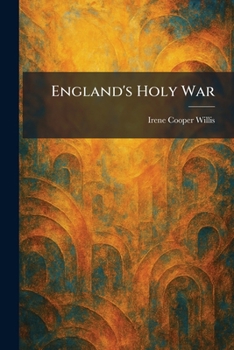
England's Holy War

"England's Holy War" is a profound critique of the intellectual and psychological shift within the British Liberal party and press during the onset and progression of World War I. Written by the noted pacifist and literary scholar Irene Cooper Willis, the work meticulously examines how a political faction initially committed to peace and neutralism eventually embraced the conflict, re-characterizing it as a moral and "holy" crusade for democracy and civilization.
Through a sharp analysis of contemporary journalism and the writings of influential liberal thinkers, Willis exposes the rhetoric used to reconcile liberal ideals with the brutal realities of total war. The book serves as both a historical document of the Great War era and a timeless study of political propaganda and ideological transformation. It explores the power of the press to shape public sentiment and the ease with which humanitarian principles can be co-opted for military purposes. Willis's account remains a vital resource for understanding the complexities of British public opinion and the disillusionment that followed the war. It is an essential read for those interested in the history of pacifism, media studies, and the political landscape of early 20th-century Britain.
This work has been selected by scholars as being culturally important, and is part of the knowledge base of civilization as we know it. This work was reproduced from the original artifact, and remains as true to the original work as possible. Therefore, you may see the original copyright references, library stamps (as most of these works have been housed in our most important libraries around the world), and other notations in the work.
This work is in the public domain in the United States of America, and possibly other nations. Within the United States, you may freely copy and distribute this work, as no entity (individual or corporate) has a copyright on the body of the work.
As a reproduction of a historical artifact, this work may contain missing or blurred pages, poor pictures, errant marks, etc. Scholars believe, and we concur, that this work is important enough to be preserved, reproduced, and made generally available to the public. We appreciate your support of the preservation process, and thank you for being an important part of keeping this knowledge alive and relevant.
Customer Reviews
ThriftBooks ® and the ThriftBooks ® logo are registered trademarks of Thrift Books Global, LLC
